
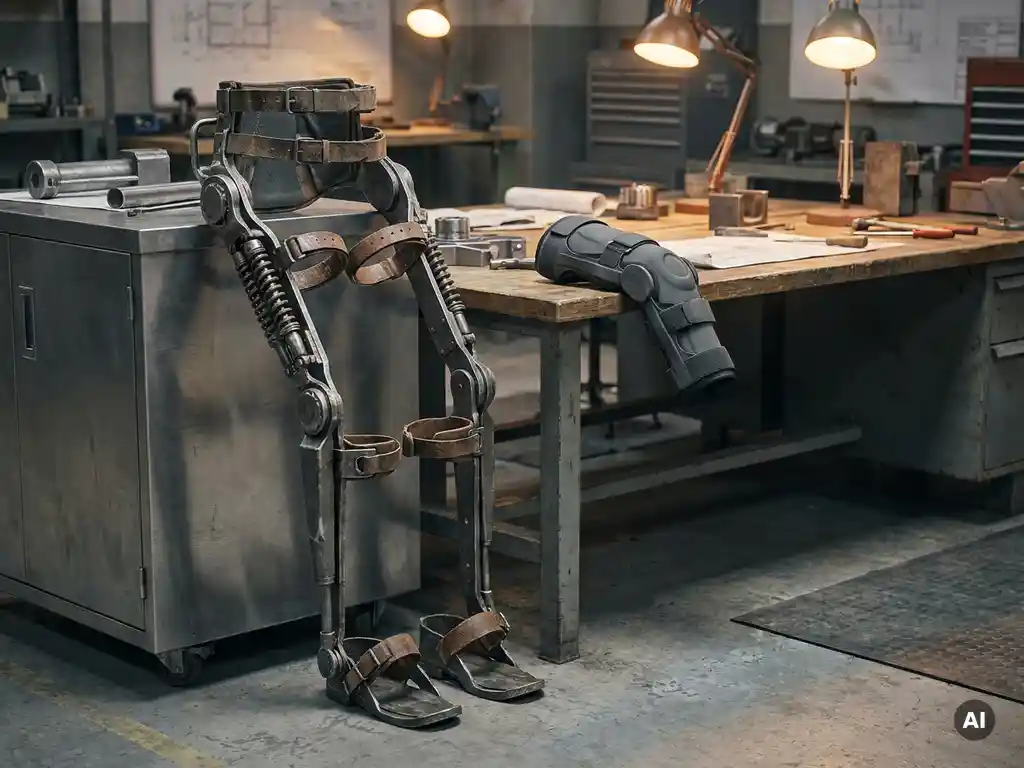
Passive defense wearables use mechanical energy storage, typically springs or elastic elements, to reduce physical strain without any power source, while active defense wearables use motors, actuators, and onboard power to amplify force and movement in real time. The right choice depends on the mission profile: passive systems excel in endurance and reliability, while active systems deliver greater assistance for demanding physical tasks. The sections below break down how each type works, where each performs best, and how to match the technology to the mission.
How do passive and active defense wearables actually work?
Passive defense wearables store and release mechanical energy using springs, elastic bands, or compliant structures. They require no battery or motor: the soldier’s own movement charges and discharges the system, redistributing load across the body or reducing peak muscle effort. Active wearables, by contrast, use powered actuators driven by onboard electronics to detect movement intent and provide motorized assistance in real time.
In practice, a passive exoskeleton for load-carrying works by transferring weight from the back and legs into a rigid frame that channels force toward the ground. The system is always on, always responsive, and never runs out of power. An active exoskeleton adds sensors and a control system that reads the wearer’s posture and motion, then fires actuators to amplify specific movements, lifting, stepping, or carrying, at precisely the right moment.
Both approaches aim to reduce the physical burden on military personnel, but they do so through fundamentally different engineering philosophies. Passive systems are elegant in their simplicity. Active systems are powerful in their adaptability. Understanding that distinction is the starting point for any serious evaluation of defense wearable technology.
What are the main advantages of passive military wearables?
Passive military wearables offer four core advantages: they are lightweight, mechanically reliable, require zero power, and are silent during operation. These qualities make them highly suitable for extended field operations where logistics, endurance, and stealth are critical factors.
Because passive systems contain no electronics or motors, they have far fewer failure points than their powered counterparts. A spring-based exoskeleton can absorb shock, redistribute load, and support the wearer’s joints across many kilometers of terrain without any maintenance beyond a basic inspection. There are no batteries to charge, no firmware to update, and no risk of power failure mid-mission.
Weight is another significant advantage. Every kilogram a soldier carries is a kilogram of fatigue. Passive systems are typically much lighter than active ones, which must carry motors, batteries, and control electronics. In scenarios such as approach marches, drop zone logistics, or forward base setups, where soldiers may be on foot for hours, this weight difference has a direct impact on operational effectiveness and physical safety.
Silence also matters in military contexts. Passive mechanical systems produce minimal noise, whereas powered exoskeletons generate motor sounds and cooling fan noise that can compromise stealth in sensitive environments.
When do active exoskeletons outperform passive ones in defense?
Active exoskeletons outperform passive systems when the task demands substantial, controlled force assistance, particularly for lifting heavy loads from the ground, operating in unpredictable terrain, or supporting soldiers with specific physical limitations. The powered actuation allows the system to adapt dynamically to what the wearer is doing, rather than relying on the wearer’s own movement to drive the mechanism.
Consider a scenario where a soldier must repeatedly lift and load heavy equipment onto a vehicle. A passive system can reduce the sustained load during carrying, but it cannot meaningfully assist with the explosive effort of lifting from a stationary position. An active exoskeleton can detect the lifting motion and provide direct motorized support at the hip and knee, significantly reducing the injury risk associated with repetitive heavy lifting.
Active systems also offer greater programmability. Engineers can tune the assistance profile for specific tasks, body types, or mission requirements. This makes active exoskeletons particularly valuable in structured environments such as forward operating bases, logistics hubs, or vehicle maintenance operations, where the range of physical tasks is well defined and power supply is accessible.
What are the biggest limitations of active wearables in military use?
The biggest limitations of active military wearables are battery life, weight, mechanical complexity, and noise. These factors can make powered exoskeletons impractical for many frontline or field-based applications, despite their performance advantages in controlled settings.
Battery life remains the most significant operational constraint. Current battery technology limits the operational window of most active exoskeletons to a few hours of intensive use. In a military context, where resupply may be impossible and missions can last well beyond that window, a system that stops working mid-operation is not just inconvenient: it can become a hazard. The wearer may be left carrying both the weight of their load and the dead weight of an unpowered exoskeleton frame.
Mechanical complexity also increases maintenance burden. Active systems require trained technicians to service motors, sensors, and software, a level of logistical support that is difficult to sustain in forward-deployed environments. A fault in a passive spring system can often be identified visually and managed in the field. A fault in an active system’s control electronics typically cannot.
Finally, the weight of batteries and actuators adds to the soldier’s overall load, partially offsetting the assistance the system provides. This creates a trade-off that mission planners must carefully evaluate before committing to active wearable deployment.
Which type of defense wearable is better suited for which mission?
Passive wearables are better suited for long-duration, mobility-intensive missions where endurance, stealth, and reliability matter most. Active wearables are better suited for high-intensity, task-specific operations in environments where power access and maintenance support are available.
A useful way to think about this is by mission phase:
- Approach and infiltration: Passive systems are the clear choice. Soldiers need to cover distance quietly, conserve energy, and carry their equipment reliably. A lightweight passive exoskeleton reduces cumulative fatigue without adding electronic complexity or noise.
- Base logistics and resupply: Active systems can add real value here. Tasks like unloading vehicles, moving ammunition, or setting up equipment involve repetitive heavy lifting in a relatively controlled environment with access to charging infrastructure.
- Medical evacuation and casualty carry: Both types have a role, but passive systems are often preferred for their immediate availability and zero-power operation. Carrying a casualty is unpredictable in duration and route, making battery dependency a genuine risk.
- Specialized unit support: Active exoskeletons can be tailored to specific roles, combat engineers, vehicle crews, or medical personnel, where the physical demands are well understood and logistical support is structured.
The choice is rarely binary. Many military programs are exploring hybrid approaches that combine passive energy-balancing elements with targeted powered assistance, seeking to capture the reliability of passive systems alongside the adaptability of active ones. Understanding the engineering principles behind each approach is essential for making that call effectively.
How InteSpring helps with defense wearables
We develop and consult on defense wearable technology with a specific focus on passive and semi-passive systems that are built for real operational conditions. Our work combines deep expertise in spring-based energy balancing, human movement biomechanics, and mechatronic engineering to create solutions that are practical, reliable, and field-ready.
Here is what we bring to defense wearable development:
- Proven passive exoskeleton technology: Our Centaur leg exoskeleton is a lightweight, semi-passive system developed for the Dutch Ministry of Defense, designed specifically for load-carrying during approach marches, drop zone logistics, and forward base operations.
- Full development support: We guide projects through our four-phase consultancy process, from feasibility assessment and demonstrator prototypes through to detailed design and serial production supply chain setup.
- Hands-on demonstrations: We offer live exoskeleton demonstrations featuring more than six different systems, giving defense clients direct experience with the technology before committing to development or procurement.
- Hybrid technology expertise: We have developed specialized microhydraulics tailored to the wearable and exoskeleton market, giving us a unique capability to combine passive and active elements in ways that maximize field performance.
- Expert guidance on implementation: We provide presentations and strategic advice on how to integrate wearable technology into existing operational frameworks, including training, maintenance planning, and procurement.
If you are evaluating passive or active wearables for a defense application and want expert guidance grounded in real engineering experience, we would be glad to talk. Contact us to discuss your mission requirements and find out how we can support your project.