
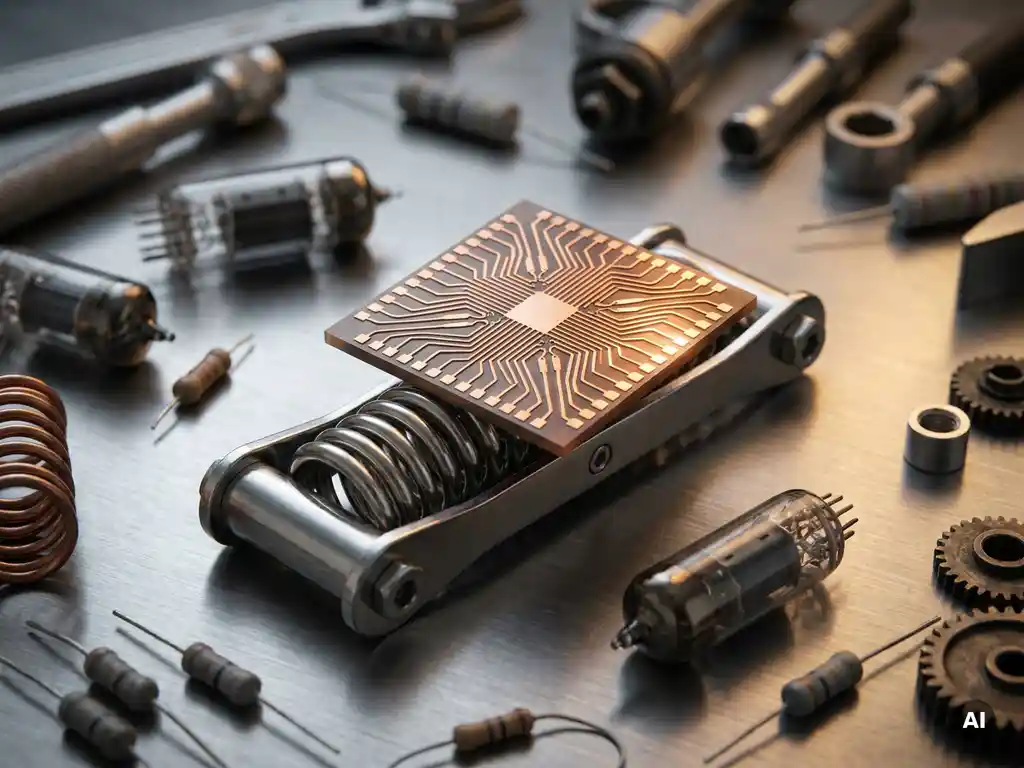
Neuromorphic chips are cheaper to deploy than traditional sensor arrays primarily because they process data at the sensor level, eliminating the need for centralized computing infrastructure and dramatically reducing power consumption. Instead of streaming raw data to external processors, neuromorphic chips handle computation locally, which cuts both hardware costs and ongoing energy bills. The sections below break down each cost driver in detail.
How do neuromorphic chips process sensor data differently?
Neuromorphic chips process sensor data using event-based sensing, meaning they only respond and compute when something in the environment actually changes. Traditional sensors continuously sample their surroundings at fixed intervals and send every reading downstream for processing, regardless of whether anything meaningful happened. Neuromorphic chips, by contrast, fire only when a threshold is crossed, mimicking how biological neurons behave.
This fundamental difference has cascading effects on system design. Because computation happens at the edge, close to the source of the data, there is no need for a separate, power-hungry processor sitting downstream to interpret a constant stream of readings. The chip integrates sensing and processing into a single unit, which reduces component count and simplifies the overall architecture. For applications like gunshot detection technology, this matters enormously: an event-based sensor can identify the acoustic signature of a shot in microseconds without wasting resources monitoring silence.
Why does power consumption make traditional sensor arrays expensive?
Traditional sensor arrays are expensive to run because they consume power continuously, whether or not useful data is being collected. Every sensor in the array draws current to sample, convert, and transmit data at a fixed rate. Multiply that across dozens or hundreds of sensors in a large deployment, and the energy cost becomes a significant operational expense, especially in remote or battery-powered installations.
In contrast, neuromorphic chips operate asynchronously. They consume power only during an event, which means idle periods cost almost nothing. For deployments in defense, logistics, or industrial monitoring, where sensors may sit dormant for long stretches between meaningful events, this difference in power profile translates directly into lower battery replacement costs, smaller power supplies, and reduced infrastructure for power delivery. Over months and years, the savings compound considerably.
What hardware costs does neuromorphic computing eliminate?
Neuromorphic computing eliminates the need for several hardware components that traditional sensor arrays require as standard. Because processing happens on-chip, engineers can remove or downsize the central processing units, analog-to-digital converters, and data buffers that would otherwise be needed to handle a continuous sensor stream.
- Dedicated edge processors: Traditional setups often pair each sensor cluster with a microcontroller or FPGA to pre-process data. Neuromorphic chips absorb this function internally.
- High-bandwidth communication modules: Sending raw sensor data requires fast, often expensive wireless or wired links. Event-based sensing vs. traditional sensors shows a stark difference here, since far fewer bytes need to travel across the network.
- Cooling systems: Dense processing hardware generates heat. Neuromorphic chips run cool enough in most deployments that active cooling becomes unnecessary.
- Power regulation circuitry: Lower and more variable power draw simplifies the power management hardware required around the chip.
Together, these eliminations can meaningfully reduce the bill of materials for a sensor deployment, particularly at scale.
How does data bandwidth affect the total deployment cost of sensor systems?
Data bandwidth is one of the largest hidden costs in traditional sensor array deployments. Every byte of raw sensor data that travels from a sensor to a central server requires network capacity, and that capacity costs money to build, license, and maintain. In a large-scale deployment, bandwidth costs can rival or exceed the cost of the sensors themselves.
Event-based sensing addresses this directly. Because a neuromorphic chip only transmits data when an event occurs, the volume of data moving across the network drops dramatically. In environments with sparse events, such as perimeter security or gunshot detection technology in low-activity zones, the reduction can be several orders of magnitude. Smaller data payloads mean cheaper network infrastructure, lower cloud storage fees, and faster response times because the system is not wading through irrelevant data to find meaningful signals.
Are neuromorphic chips cheaper to maintain over time than sensor arrays?
Yes, neuromorphic chips tend to be cheaper to maintain over time than traditional sensor arrays, for several interconnected reasons. Fewer components mean fewer points of failure. Lower power draw extends battery life in wireless deployments, reducing the frequency of physical maintenance visits. And because the chips process data locally, there is less dependence on cloud infrastructure that requires ongoing licensing and management.
Traditional sensor arrays often require regular firmware updates to the central processing layer, calibration of analog components, and replacement of batteries or power units across many nodes. Each maintenance visit carries a labor cost, and in difficult-to-reach locations, that cost rises sharply. Neuromorphic systems consolidate these responsibilities into a more self-contained unit, which lowers the total cost of ownership over a multi-year deployment horizon.
What types of applications benefit most from neuromorphic chip deployment?
Applications that benefit most from neuromorphic chip deployment share a common characteristic: they need to detect rare, fast, or subtle events within a large volume of background noise while operating under tight power or bandwidth constraints.
- Gunshot detection technology: Acoustic event-based sensors can identify the precise signature of a gunshot in real time without processing hours of ambient sound, making them highly effective for defense and public safety applications.
- Wearable technology and exoskeletons: Devices worn on the body must be light and energy-efficient. Neuromorphic chips enable real-time motion sensing and adaptive control without draining batteries rapidly.
- Industrial anomaly detection: Monitoring machinery for faults requires sensitivity to rare events against a backdrop of normal operation, exactly the scenario where event-based sensing outperforms traditional polling approaches.
- Agricultural and environmental monitoring: Remote sensor networks in fields or forests benefit from the long battery life that neuromorphic chips enable, reducing the need for frequent maintenance in hard-to-reach locations.
- Defense and logistics: Lightweight, low-power sensor nodes are essential for soldiers and field operators who cannot carry heavy power supplies or rely on stable network infrastructure.
How InteSpring helps with neuromorphic and sensor-driven wearable technology
At InteSpring, we bring deep expertise in energy-efficient mechanical and mechatronic systems to projects where sensor integration, power management, and real-world performance all need to work together. Our work on exoskeletons and wearable orthoses means we understand exactly how neuromorphic chip architectures fit into force-balancing and human-interactive devices, where every gram and every milliwatt counts.
Here is what we offer in this space:
- Feasibility assessment: We evaluate whether neuromorphic or event-based sensing is the right fit for your application, looking at power budgets, data requirements, and environmental conditions.
- System integration: We integrate sensor solutions into wearable and mechanical platforms, from initial concept through to functional prototypes.
- Mechatronic design: Our team combines mechanical engineering, embedded systems, and human movement expertise to design sensor-driven systems that are practical to deploy and maintain.
- Demonstrator development: We build working demonstrators so you can validate the technology before committing to full-scale production.
- Supply chain setup: We help establish a reliable supply chain for serial production of certified products.
If you are exploring how neuromorphic chips or event-based sensing could reduce deployment costs in your application, we would love to talk. Get in touch with our team to discuss your project and find out how we can help you move from concept to certified product efficiently and effectively.
Related Articles
- What is a helmet-mounted sensor system and what does it do?
- What role does neuromorphic processing play in noise rejection?
- How does event-based sensing differ from traditional sensors?
- What is the difference between gravity balancing and counterweights?
- How do you request an exoskeleton demonstration for military units?