
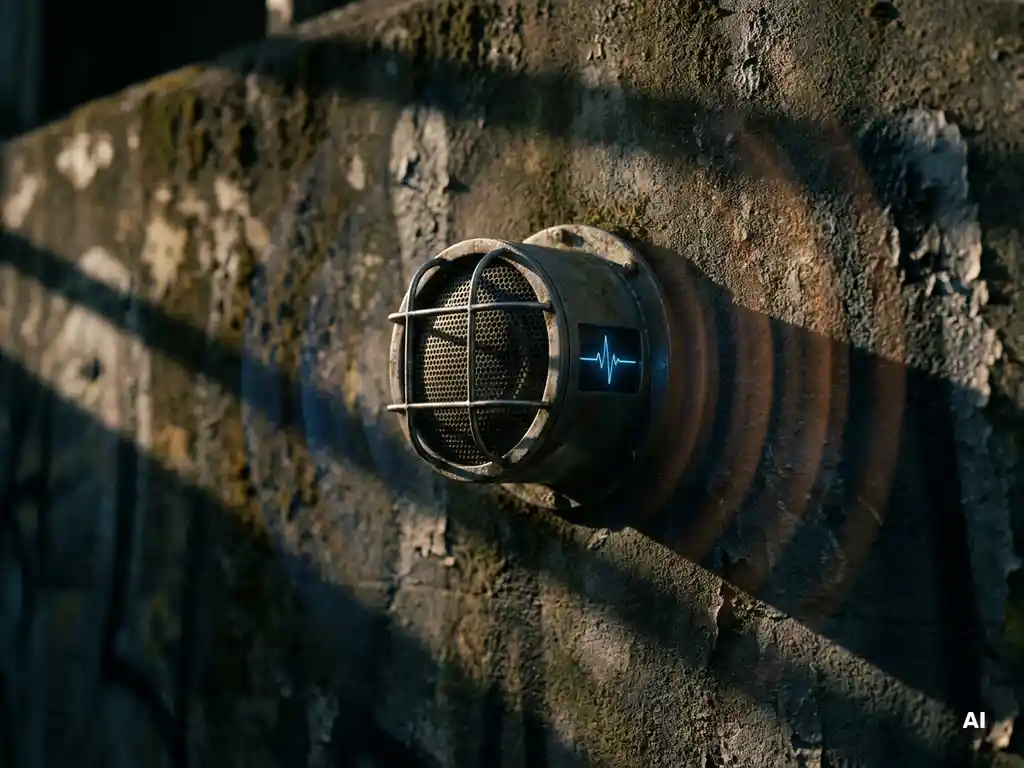
Sparse data processing makes gunshot detection more reliable by drastically reducing the volume of irrelevant acoustic information a system must analyse, allowing algorithms to focus exclusively on the sharp, transient signal signatures that characterise a gunshot. Instead of processing a continuous stream of audio data, sparse methods capture and act only on meaningful changes in the acoustic environment. The sections below unpack how this works across sensing hardware, detection accuracy, localization speed, and current system limitations.
What makes gunshot detection difficult with conventional data methods?
Conventional data methods struggle with gunshot detection because they process audio as a continuous, unfiltered stream, which floods processing pipelines with ambient noise, echoes, and irrelevant environmental sounds. A gunshot is an extremely brief, high-energy acoustic event, and identifying it reliably inside a dense stream of background data demands enormous computational resources and introduces significant latency.
Traditional sensors sample the environment at a fixed rate regardless of whether anything meaningful is happening. In urban or forested environments, this means the system is constantly ingesting wind noise, traffic, machinery, and human activity. Distinguishing a muzzle blast from a car backfire or a metal door slamming becomes a classification problem that conventional threshold-based detectors frequently get wrong, producing both false positives and missed detections.
The data volume problem is compounded in multi-sensor arrays. When several microphones or acoustic sensors feed data simultaneously into a central processor, the bandwidth and storage requirements scale rapidly. Synchronising that data for localization purposes adds another layer of complexity. The result is a system that is either slow, expensive, or prone to error under real-world conditions.
How does sparse data processing work in acoustic sensing?
Sparse data processing in acoustic sensing works by recording and transmitting only the data points that represent a meaningful change in the signal, rather than sampling the environment at a fixed, continuous rate. This event-driven approach is closely associated with neuromorphic chip architectures and event-based sensing, where each sensor element fires independently the moment it detects a significant deviation from baseline.
In practical terms, an event-based microphone or acoustic sensor assigns a timestamp and a value only when the sound pressure at that element crosses a defined threshold. During quiet periods, no data is generated at all. When a gunshot occurs, its steep pressure wavefront triggers a dense burst of events across the sensor array in a matter of microseconds. The resulting sparse event stream is far smaller than a conventional audio recording of the same duration, yet it captures the temporal structure of the acoustic event with very high resolution.
Processing this sparse stream requires algorithms designed for asynchronous, timestamped data rather than fixed-frame audio buffers. Spiking neural networks and event-driven signal processors are well suited to this task because they operate on the same event-driven principle as the sensors themselves. The combination of event-based sensing hardware and sparse processing algorithms is what gives the approach its efficiency advantage over traditional sensors.
Why does sparsity improve gunshot detection accuracy?
Sparsity improves gunshot detection accuracy because it suppresses background noise at the sensor level before any algorithmic processing begins. By generating data only when a threshold is crossed, the system inherently ignores the low-level ambient noise that causes false positives in conventional detectors. The signal-to-noise ratio of the captured data is therefore much higher from the outset.
Gunshots have a distinctive acoustic fingerprint: an extremely rapid onset, a high-amplitude pressure peak, and a specific spectral decay profile. Sparse event streams preserve the fine temporal structure of this onset with sub-millisecond precision because each sensor element responds the instant the wavefront arrives. Conventional sampling at a fixed rate can smear or alias this onset depending on the sampling frequency, making classification harder.
Because the event stream is dominated by the gunshot signal rather than background clutter, classification models trained on sparse data can learn tighter decision boundaries. The result is fewer false alarms in noisy environments such as construction sites, military training areas, or busy urban streets, and fewer missed detections in low-energy scenarios such as suppressed fire or distant shots. Accuracy gains come not from more powerful hardware but from cleaner input data.
What types of sensors and systems use sparse gunshot detection?
Sparse gunshot detection is primarily implemented using event-based acoustic sensors, neuromorphic processing chips, and multi-element microphone arrays designed for asynchronous operation. These components are increasingly found in military perimeter security systems, law enforcement monitoring platforms, and smart city infrastructure.
- Event-based microphones: Silicon microphones engineered to output asynchronous events rather than sampled audio frames, enabling the sparse data pipeline from the point of capture.
- Neuromorphic chips: Processors such as Intel’s Loihi or research-grade spiking neural network hardware that are optimised for processing sparse, timestamped event streams with very low power consumption.
- Distributed sensor arrays: Networks of spatially separated acoustic nodes that each generate sparse event data, which is then fused centrally for localization and classification.
- Wearable acoustic sensors: Compact, low-power units integrated into body armour or helmet systems for personal threat detection in field environments.
The event-based sensing versus traditional sensors distinction is especially relevant in battery-powered or edge-deployed systems, where the power savings from not continuously streaming audio can extend operational life by an order of magnitude. This makes sparse detection particularly attractive for remote or unattended sensor nodes.
How does sparse processing affect gunshot localization speed?
Sparse processing significantly accelerates gunshot localization because the precise arrival timestamps generated by event-based sensors can be used directly for time-difference-of-arrival calculations without first converting continuous audio into discrete frames. This removes a key processing step that introduces latency in conventional systems.
In a traditional acoustic localization pipeline, the system must buffer a window of audio, apply a cross-correlation algorithm across multiple channels, and then estimate the direction or position of the source. Each buffering and processing step adds tens to hundreds of milliseconds of delay. In a sparse event-driven pipeline, the arrival time of the gunshot wavefront at each sensor is recorded with microsecond precision the instant it occurs, and the localization calculation can begin immediately.
The practical outcome is that sparse systems can report a threat direction or position in a fraction of the time required by conventional approaches. In security and defence applications, this difference between a localization result delivered in under 100 milliseconds versus several hundred milliseconds can be operationally significant, allowing personnel or automated systems to respond before a second shot is fired.
What are the current limitations of sparse gunshot detection systems?
Despite their advantages, sparse gunshot detection systems face several real-world limitations that affect deployment at scale. The technology is maturing rapidly, but engineering challenges remain in hardware standardisation, algorithm robustness, and integration with existing infrastructure.
- Threshold calibration: Event-based sensors require careful tuning of their detection thresholds for each deployment environment. A threshold set too low generates excessive noise events; one set too high risks missing low-energy acoustic events such as suppressed gunfire.
- Training data scarcity: Classification models for sparse event streams require labelled datasets of gunshot events captured by event-based sensors specifically, which are far less abundant than conventional audio recordings.
- Hardware availability: Neuromorphic chips and event-based acoustic sensors remain specialist components with limited commercial availability compared to standard audio hardware, raising procurement and maintenance challenges.
- Multipath interference: In complex acoustic environments such as urban canyons or indoor spaces, reflected wavefronts can generate spurious events that complicate localization even in sparse systems.
- Interoperability: Integrating sparse event-driven sensor nodes with existing command-and-control systems designed for conventional data formats requires custom middleware, adding integration cost and complexity.
Research in 2026 is actively addressing several of these constraints, particularly through advances in on-chip learning that allow neuromorphic processors to adapt their detection thresholds autonomously based on environmental conditions. As the ecosystem of event-based sensing hardware grows, many of the current procurement and standardisation barriers are expected to diminish.
How InteSpring supports advanced sensing and wearable technology development
At InteSpring, we combine deep expertise in mechatronics, embedded systems, and human-interactive engineering to support the development of sophisticated sensing and wearable technologies. While our core focus is on spring-based energy balancing, our engineering consultancy capabilities extend directly into the kind of compact, power-efficient, and mechanically robust systems that sparse gunshot detection hardware demands.
We offer structured support across the full development cycle, from initial concept to certified product:
- Feasibility studies to assess the technical and economic viability of integrating sparse sensing hardware into defence or security wearables.
- Demonstrator development to build functional prototypes that validate event-based sensing concepts in realistic operational conditions.
- Detailed mechanical and mechatronic design to ensure sensor housings, wearable mounts, and power systems meet the weight, durability, and ergonomic requirements of field deployment.
- Supply chain setup for serial production of specialist components, leveraging our established network of precision engineering suppliers.
Our work on platforms such as the Centaur exoskeleton for the Dutch Ministry of Defence demonstrates our ability to deliver robust, field-ready systems in demanding environments. If you are developing or integrating advanced acoustic sensing technology and need an engineering partner with hands-on experience in wearable and defence systems, we would welcome the conversation. Get in touch with us to discuss how we can support your project from concept through to production.