
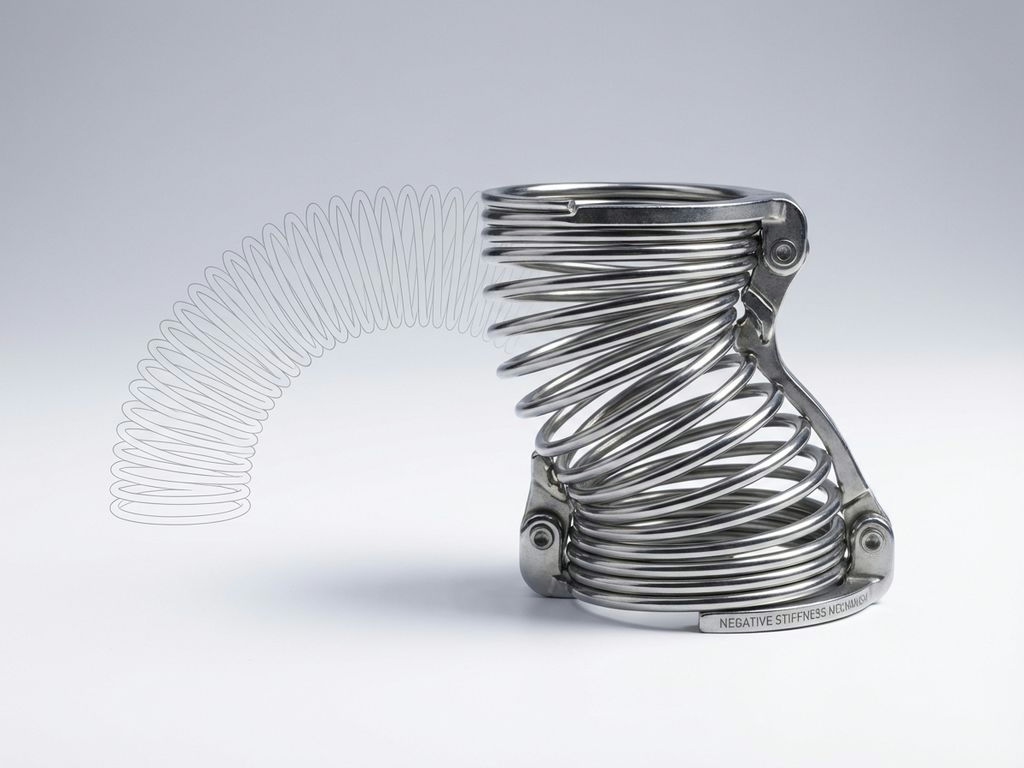
Negative stiffness is a counterintuitive mechanical property in which a spring or mechanism provides less resistance as it is compressed or stretched, opposite to traditional springs that become stiffer under load. This technology enables systems that can store and release energy in ways that support natural movement patterns, making it valuable for exoskeletons, medical devices, and force compensation applications.
What is negative stiffness and how does it work?
Negative stiffness occurs when a mechanical system becomes less resistant to deformation as force increases, creating a force–displacement relationship opposite to that of conventional springs. Unlike traditional positive-stiffness springs that push back harder when compressed, negative stiffness mechanisms reduce their resistance force as displacement increases.
The fundamental physics behind negative stiffness involves carefully designed energy storage and release mechanisms. Engineers achieve this through specific geometric configurations, such as bistable mechanisms or specially shaped spring elements that create regions where the force decreases with increasing displacement. These systems store potential energy in one configuration and release it in a controlled manner that assists rather than resists movement.
Common implementations include buckled beams, inverted pendulum systems, and specially designed cam mechanisms. The key lies in creating a force profile that matches the requirements of the application, whether that is compensating for gravitational forces in wearable devices or providing assistance during specific phases of human movement.
Why does negative stiffness matter in real-world applications?
Negative stiffness technology matters because it enables energy-efficient force compensation that works with natural movement patterns rather than against them. This approach reduces the energy requirements for mechanical assistance systems and creates more comfortable user experiences in wearable technologies.
In practical applications, negative stiffness provides several important benefits. It allows mechanical systems to offset gravitational forces without requiring continuous power input, making devices lighter and more sustainable. The technology also enables more natural movement patterns by providing assistance precisely when and where it is needed most.
Force compensation applications benefit significantly from negative stiffness because the system can be tuned to match specific load profiles. This means exoskeletons can provide support during the most demanding phases of movement while allowing unrestricted motion during lighter activities. The result is improved user comfort and reduced fatigue during extended use.
How is negative stiffness used in exoskeletons and medical devices?
In exoskeletons and medical devices, negative stiffness creates passive assistance systems that support users without requiring motors or batteries. These mechanisms provide targeted support during specific movement phases while allowing natural motion during others, improving both effectiveness and user acceptance.
Exoskeleton applications use negative stiffness to offset the weight of heavy equipment or provide lifting assistance. The technology enables devices that feel natural to wear because they work with the body’s biomechanics rather than imposing artificial movement patterns. This approach reduces the bulk and complexity typically associated with powered exoskeleton systems.
Medical orthotic devices benefit from negative stiffness by providing corrective forces that adapt to patient movement. For conditions such as pes equinus, negative stiffness mechanisms can counteract abnormal muscle tension while allowing normal ankle movement. Advanced solutions like the Hermes ankle orthosis demonstrate how this technology creates therapeutic devices that patients can wear comfortably throughout daily activities while receiving continuous treatment benefits.
What is the difference between positive and negative stiffness systems?
Positive stiffness systems increase resistance as they are deformed, storing energy that pushes back toward the original position. Negative stiffness systems decrease resistance with deformation, creating force profiles that can assist movement or offset external loads rather than opposing them.
Traditional positive-stiffness springs work well for applications requiring restoring forces, such as suspension systems or energy storage. They provide stability and return systems to equilibrium positions. However, they are less suitable for applications requiring force assistance or gravitational compensation because they always oppose displacement.
The optimal approach often involves combining both types of stiffness in a single system. Engineers can create mechanisms with regions of positive and negative stiffness, allowing precise control over force profiles. This combination enables systems that provide stability where needed while offering assistance during specific operational phases.
How do engineers design effective negative stiffness mechanisms?
Engineers design negative stiffness mechanisms by carefully controlling geometric configurations and material properties to create specific force–displacement relationships. The design process involves precise mathematical modelling to predict system behaviour and ensure stable operation across the intended range of motion.
Material selection plays an important role in negative stiffness design. Engineers must choose materials with appropriate elastic properties and fatigue resistance for the intended application. The geometric configuration determines the force profile, requiring careful analysis of beam shapes, pivot points, and constraint locations to achieve the desired negative stiffness characteristics.
Integration challenges include ensuring system stability and preventing unwanted oscillations or snap-through behaviour. Engineers must consider manufacturing tolerances, wear characteristics, and environmental factors that could affect performance. The design must also accommodate the specific requirements of the target application, whether that is weight constraints for wearable devices or force output requirements for industrial applications.
How InteSpring helps with negative stiffness solutions
We specialise in developing negative stiffness solutions that address real-world force compensation challenges in exoskeletons, medical devices, and industrial applications. Our expertise in spring systems and energy balancing enables us to create innovative mechanisms that provide precise force profiles while maintaining reliability and user comfort.
Our approach to negative stiffness solutions includes:
- Custom mechanism design tailored to specific force compensation requirements
- Integration of negative stiffness elements with traditional spring systems for optimal performance
- Prototype development and testing to validate performance across operational conditions
- Manufacturing support to ensure consistent production quality and performance
Whether you are developing exoskeletons for defence applications, medical orthoses for patient rehabilitation, or industrial systems requiring force assistance, we can help you implement effective negative stiffness solutions. Contact us to discuss how our expertise in gravitational force compensation and spring mechanics can support your project requirements.
Related Articles
- What role does neuromorphic processing play in noise rejection?
- How do spring systems enable effective energy balancing?
- What Is Energy Balancing? Principles, Methods, and Applications
- What are the benefits of combining physical therapy with adaptive orthoses?
- How do mobility aids improve quality of life?