
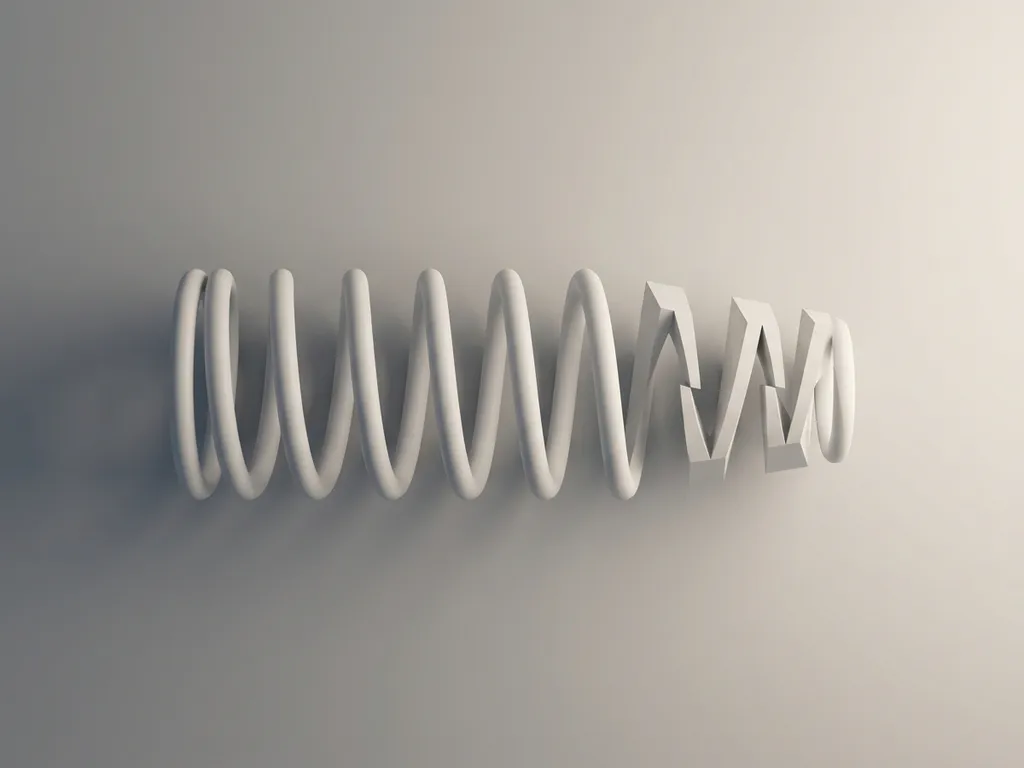
Spring mechanisms form the backbone of countless mechanical systems, from the simple ballpoint pen in your hand to sophisticated exoskeletons that assist human movement. These ingenious devices store and release energy through elastic deformation, enabling everything from shock absorption in vehicles to precise force control in medical devices. Understanding how springs work—from traditional coil designs to cutting-edge compliant flexures—opens the door to innovative engineering solutions across industries.
This guide will take you through the fundamental principles of spring technology, exploring how different mechanisms store energy and the design considerations that make modern spring systems so versatile. Whether you’re an engineer looking to deepen your understanding or simply curious about the mechanics behind everyday objects, you’ll discover how springs have evolved from simple metal coils into sophisticated systems that can enhance human performance and machine efficiency.
What Are Spring Mechanisms and Why Do They Matter?
A spring mechanism is any device that stores mechanical energy through elastic deformation and releases that energy when the deforming force is removed. At its core, a spring converts applied force into stored potential energy, then returns that energy as kinetic force when released. This fundamental principle makes springs essential components in systems requiring force storage, vibration control, or energy return.
Spring mechanisms matter because they provide predictable, repeatable force characteristics without requiring external power sources. Unlike motors or hydraulic systems that need continuous energy input, springs operate passively, making them ideal for applications where reliability, simplicity, and energy efficiency are paramount. They can absorb shock loads, provide constant force over a range of motion, or return systems to predetermined positions.
Consider the suspension system in your car: springs absorb the impact energy from road irregularities and gradually release it, providing a smooth ride while maintaining tire contact with the road. This same principle applies to exoskeletons that assist human movement, where springs can store energy during one phase of motion and release it during another, reducing the metabolic cost of walking or lifting.
How Traditional Coil Springs Store and Release Energy
Traditional coil springs operate on the principle of elastic deformation in torsion. When you compress or extend a coil spring, you’re actually twisting the wire material around its axis. The spring wire experiences shear stress as the coils are forced closer together or pulled apart, storing energy in the material’s elastic properties.
The energy storage capacity of a coil spring depends on several key factors: the wire diameter, coil diameter, number of active coils, and the material’s elastic modulus. Hooke’s Law governs this relationship, stating that the force required to deform a spring is proportional to the displacement. This linear relationship makes coil springs predictable and easy to calculate, which explains their widespread use in mechanical design.
For example, when you press down on a car’s suspension spring, the wire twists as the coils compress. The energy you input is stored in the twisted wire material. When you release the force, the wire’s tendency to return to its original shape drives the spring back to its natural length, releasing the stored energy. This process can repeat millions of times without significant degradation if the spring is properly designed and operated within its elastic limits.
Understanding Compliant Flexure Technology
Compliant flexure technology represents a fundamental shift from traditional spring design, using the bending properties of solid materials rather than coiling or twisting mechanisms. A flexure spring consists of thin, flexible elements that bend elastically when loaded, storing energy in the material’s flexural deformation rather than torsional stress.
Unlike coil springs that rely on wire geometry, flexures derive their spring characteristics from the material properties and cross-sectional design of flexible beams, plates, or complex geometries. This approach eliminates the need for separate moving parts, reducing friction, wear, and maintenance requirements. Flexures can be designed to provide highly specific motion paths, force profiles, and stiffness characteristics that would be difficult or impossible to achieve with traditional springs.
Modern manufacturing techniques, particularly precision machining and additive manufacturing, have revolutionized flexure design possibilities. Engineers can now create intricate flexure patterns within a single piece of material, incorporating multiple spring elements with varying stiffness properties. For instance, a flexure-based mechanism might combine soft elements for fine motion control with stiffer elements for structural support, all integrated into one component.
Design Principles for Modern Spring Applications
Modern spring design requires balancing multiple performance criteria while considering manufacturing constraints and application requirements. The primary design principles include defining the required force-displacement relationship, selecting appropriate materials for the operating environment, and optimizing geometry for the intended service life.
Force-displacement characteristics form the foundation of spring design. Linear springs provide constant stiffness, making them suitable for applications requiring predictable force relationships. However, many modern applications benefit from non-linear spring characteristics, such as progressive springs that become stiffer as they compress, or negative stiffness springs that assist motion in specific directions. The choice depends on whether the application requires energy storage, force control, or motion assistance.
Material selection significantly impacts spring performance and longevity. Traditional steel springs excel in high-force applications but may suffer from corrosion or fatigue in demanding environments. Advanced materials like titanium alloys, carbon fiber composites, or specialized spring steels offer enhanced performance characteristics such as corrosion resistance, reduced weight, or improved fatigue life. The operating temperature, chemical exposure, and required service life all influence material selection.
- Fatigue resistance: Springs must withstand millions of cycles without failure
- Environmental compatibility: Materials must resist corrosion, temperature extremes, and chemical exposure
- Manufacturing feasibility: Complex geometries must be producible within cost constraints
- Integration requirements: Springs must interface effectively with surrounding components
How InteSpring Helps with Spring Mechanism Development
We specialize in developing advanced spring mechanisms that balance force and gravity to enhance both human and machine performance. Our expertise spans from traditional mechanical springs to cutting-edge compliant flexure systems, with particular focus on applications requiring precise force control and energy efficiency.
Our comprehensive approach to spring mechanism development includes:
- Feasibility analysis to determine the technical and economic viability of spring-based solutions
- Concept development and prototyping using our in-house capabilities and specialized supplier network
- Detailed design optimization incorporating mechanical, structural, and human-interactive engineering principles
- Product development support to establish sustainable manufacturing and supply chains
Whether you’re developing exoskeletons, medical devices, or industrial equipment requiring sophisticated force management, our team of spring engineering specialists can guide your project from initial concept through a certified product. Contact us to discuss how our spring mechanism expertise can enhance your next engineering project.