
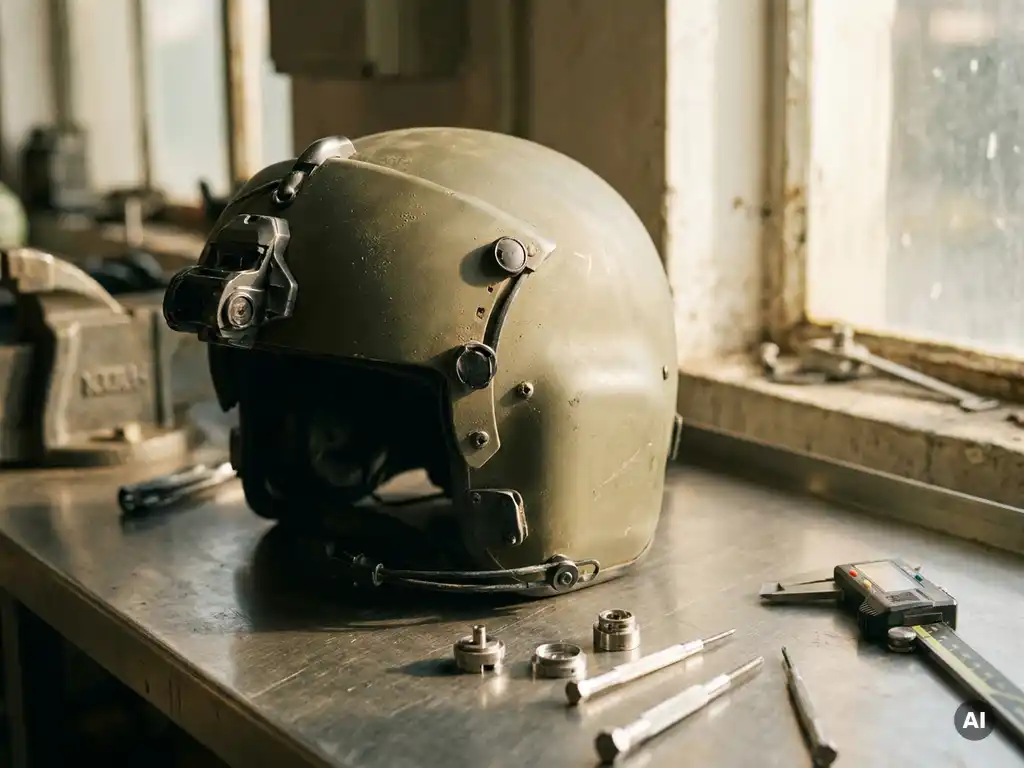
A helmet-mounted sensor system is a set of electronic sensors and processing components integrated into or onto a helmet to collect real-time data about the wearer’s environment, movement, and physiological state. These systems are designed to give the wearer, or a remote command, immediate, actionable awareness without requiring hands-free interaction. The sections below unpack how these systems work, what they measure, and why they matter in defense and wearable technology contexts.
How does a helmet-mounted sensor system work?
A helmet-mounted sensor system works by embedding one or more sensors directly into the helmet structure, connecting them to an onboard processor that captures, filters, and transmits data in real time. The processor interprets raw sensor input, applies algorithms to extract meaningful information, and either displays it to the wearer or sends it to an external system via a wireless link.
The core workflow follows three stages: data capture, processing, and output. During capture, sensors continuously sample their environment, measuring motion, light, sound, temperature, or biological signals depending on the sensor type. The onboard processor then cleans the data and runs it through filtering algorithms to remove noise. Finally, the output stage delivers the result as a visual overlay in a heads-up display, a data stream sent to a base station, or a signal that triggers another system such as an exoskeleton or communication device.
Power management is a critical design consideration. Because the system must run continuously without adding excessive weight to the helmet, engineers balance battery capacity, processor efficiency, and sensor sampling rates carefully. Many modern systems use low-power microcontrollers and duty-cycling, switching sensors on and off in rapid intervals, to extend operational time.
What types of sensors are typically used in helmet-mounted systems?
Helmet-mounted systems typically use a combination of inertial measurement units (IMUs), cameras, environmental sensors, and biometric sensors. The exact combination depends on the application, but most defense and industrial systems layer several sensor types together to build a complete picture of the wearer’s situation.
- Inertial measurement units (IMUs): Accelerometers and gyroscopes that track head orientation, movement speed, and posture in real time.
- Cameras and optical sensors: Forward-facing or wide-angle cameras for situational awareness, night vision, or augmented reality overlays.
- Environmental sensors: Devices that measure temperature, humidity, air quality, or the presence of hazardous gases in the surrounding environment.
- Acoustic sensors: Microphones or directional sound detectors used for communication, threat detection, or noise-level monitoring.
- Biometric sensors: Heart rate monitors, electroencephalography (EEG) electrodes, or skin conductance sensors that track the wearer’s physiological state and fatigue level.
- GPS and positioning modules: Location tracking components that feed into navigation systems or allow remote operators to monitor troop positions.
What data does a helmet-mounted sensor system collect?
A helmet-mounted sensor system collects data across three broad categories: positional data (where the wearer is and how their head is oriented), environmental data (what conditions surround the wearer), and physiological data (how the wearer’s body is responding to those conditions). Together, these data streams create a comprehensive operational picture.
Positional data includes GPS coordinates, heading direction, and head tilt angles. This information is especially valuable in defense technology applications where command centers need to track individual soldiers across terrain in real time. Environmental data covers temperature, lighting conditions, and potential chemical or acoustic threats. Physiological data, heart rate, cognitive load estimates from EEG signals, or fatigue indicators, gives commanders or medical personnel early warning of a soldier’s declining performance before it becomes a safety issue.
When all three data streams are fused together, the system can support automated alerts. For example, a combination of elevated heart rate, high ambient temperature, and reduced head movement might trigger a heat stress warning before the wearer is consciously aware of the problem.
Where are helmet-mounted sensor systems used?
Helmet-mounted sensor systems are used primarily in defense and military settings, but they also appear in industrial safety, search and rescue, sports performance, and medical rehabilitation. The common thread across all applications is the need for hands-free, continuous data collection in dynamic or high-risk environments.
In military and defense contexts, these systems support situational awareness, navigation, target identification, and soldier health monitoring. Defense wearables have evolved significantly, and helmet sensors now often integrate with body-worn systems such as exoskeletons and smart vests to create a networked picture of each soldier’s status. In industrial environments, similar sensor packages monitor worker safety in construction, mining, or chemical plants, detecting falls, toxic gas exposure, or dangerous noise levels. Sports and rehabilitation applications use helmet sensors to analyze movement patterns, detect concussive impacts, and guide recovery protocols.
What are the main technical challenges of helmet-mounted sensors?
The main technical challenges of helmet-mounted sensor systems are weight and balance, power supply, data latency, and environmental durability. Each of these constraints pushes against the others, making system design a constant exercise in trade-offs.
- Weight and ergonomics: Every gram added to a helmet increases neck strain and fatigue over long missions. Sensors, batteries, and processors must be miniaturized without sacrificing performance.
- Power supply: Continuous sensor operation drains batteries quickly. Designing for multi-hour or multi-day operational windows requires careful power architecture.
- Data latency: In defense applications, a delay of even a few hundred milliseconds in sensor output can affect decision-making. Real-time processing demands fast, efficient onboard computing.
- Environmental durability: Military and industrial helmets face rain, dust, extreme temperatures, and physical impact. Sensors and their housings must meet strict ingress protection and shock-resistance standards.
- Sensor fusion complexity: Combining data from multiple sensor types accurately requires sophisticated algorithms. Calibration drift, where sensors gradually become inaccurate over time, is a persistent engineering challenge.
- Electromagnetic interference: Wireless communication components and nearby electronic equipment can interfere with sensor signals, requiring careful shielding and frequency management.
How do helmet-mounted sensors connect to exoskeletons and wearable systems?
Helmet-mounted sensors connect to exoskeletons and other wearable systems through a combination of wired body-area networks and short-range wireless protocols. The helmet acts as one node in a distributed sensing network worn across the body, sharing data with actuators, processors, and displays embedded in other parts of the system.
In wired configurations, a lightweight cable routes from the helmet along the wearer’s back to a central processing unit mounted on the torso or in a backpack. This approach offers low latency and high reliability but adds cable management complexity. Wireless configurations use protocols such as Bluetooth Low Energy or proprietary ultra-wideband links to transmit data between the helmet and the exoskeleton’s control unit, removing physical cables at the cost of slightly higher power consumption and potential interference risk.
The integration between helmet sensors and exoskeletons is particularly valuable in defense wearables. Head orientation data from an IMU, for example, can inform an exoskeleton’s load-balancing algorithm, adjusting support in real time as a soldier looks down a slope or turns to change direction. Physiological data from the helmet can also trigger the exoskeleton to modify its assistance level when the wearer shows signs of fatigue, creating a responsive system that adapts to the human rather than forcing the human to adapt to the machine. This kind of human-centered engineering is central to how modern wearable systems are designed.
How InteSpring helps with helmet-mounted sensor systems and defense wearables
We at InteSpring sit at the intersection of mechanical engineering, mechatronics, and human movement science, exactly the expertise needed to build wearable systems that integrate sensor data meaningfully. Our work on defense wearables, including the Centaur leg exoskeleton developed for the Dutch Ministry of Defense, puts us in a strong position to support projects where helmet-mounted sensors need to communicate with body-worn assistive technology.
Here is what we bring to projects in this space:
- Exoskeleton integration expertise: We design mechanical and mechatronic systems that can receive and act on sensor inputs, including data from helmet-mounted IMUs and biometric monitors.
- Modular development approach: Our four-phase consultancy process, from feasibility through to certified product, means we can enter a project at any stage, whether you need early concept validation or a production-ready design.
- In-house prototyping: We build and test functional prototypes rapidly, which is essential when validating how sensor data translates into real-world system behavior.
- Defense application experience: Our background with military clients means we understand the durability, weight, and operational requirements that defense wearables must meet.
- Microhydraulics and smart actuation: Together with our partners, we have developed microhydraulic solutions tailored to the wearable market, giving us unique options for responsive, sensor-driven actuation.
If you are developing a wearable system that needs to integrate helmet-mounted sensor data, or if you want to explore how exoskeleton technology can work alongside your existing sensor infrastructure, we would love to talk. Get in touch with our team to discuss your project and find out how we can help bring it to life.