
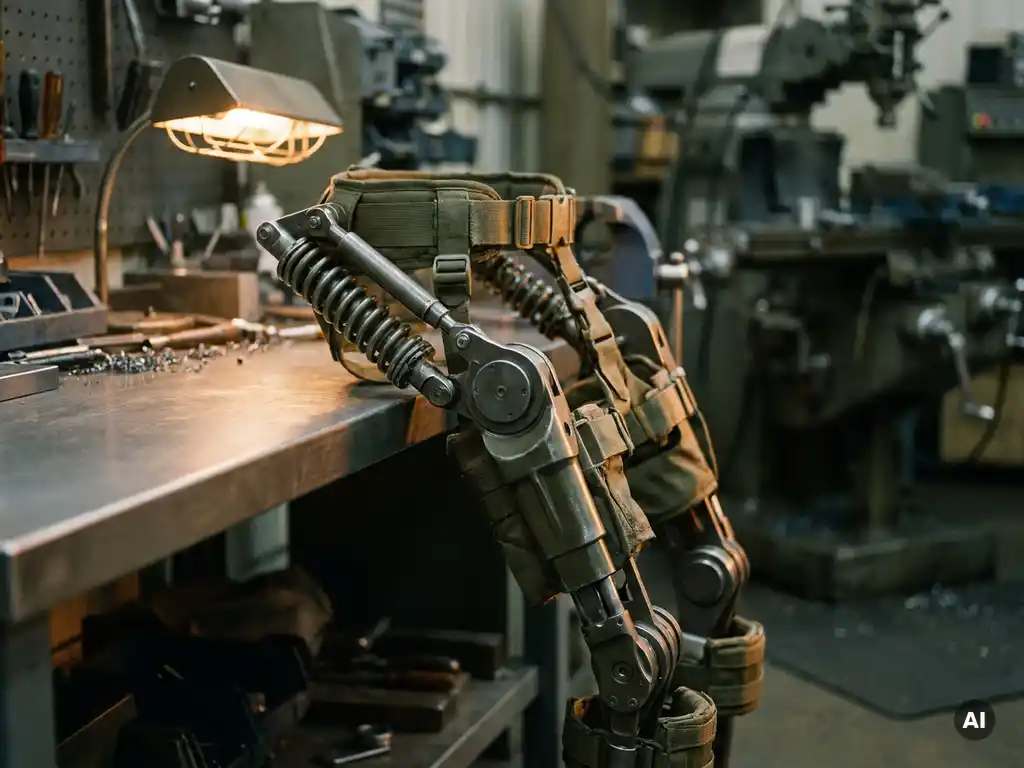
Spring-based energy balancing improves military wearable design by storing and releasing mechanical energy passively, without motors or batteries, to offset the gravitational load soldiers carry during movement. This approach reduces metabolic strain, lowers the risk of musculoskeletal injury, and keeps the system lightweight and mechanically reliable in demanding field conditions. The sections below unpack the key engineering principles, design requirements, and emerging technologies that make this possible.
What makes spring-based energy balancing different from motorized exoskeleton systems?
Spring-based energy balancing relies entirely on mechanical energy storage, using springs to absorb and return force in sync with natural body movement, rather than using electric motors or hydraulic actuators driven by onboard power. This makes spring-based systems fundamentally passive, meaning they require no battery, no control software, and no power source to function during operation.
Motorized exoskeletons, by contrast, use actuators and sensors to detect movement and apply powered assistance. While this enables a wider range of active support, it introduces significant trade-offs: weight from batteries and motors, heat generation, electronic failure points, and dependency on charging infrastructure. In environments where resupply is unreliable and equipment must survive rough handling, those trade-offs are substantial.
Passive spring systems sidestep these issues entirely. They are simpler to maintain, faster to don and doff, and far more robust in extreme conditions. The energy they store is always available, with no warm-up time and no risk of running flat mid-mission.
How does gravitational force compensation work in a load-carrying exoskeleton?
Gravitational force compensation works by using pre-tensioned springs to generate an upward force that counteracts the downward pull of gravity on a carried load. As the wearer moves, the spring mechanism continuously adjusts this counterforce to match the changing geometry of the limb, keeping the net load experienced by the body as low as possible throughout the gait cycle.
The core principle is energy conservation through mechanical design. When a soldier bends their knees or shifts their center of mass during a march, the springs store potential energy during one phase of movement and release it during another. This recycling of mechanical energy means the soldier’s muscles do less net work over time, even while carrying significant weight.
Effective gravitational compensation requires careful calibration to the wearer’s body geometry and the expected load range. The spring stiffness, attachment points, and range of motion must all be tuned so that the compensating force tracks the gravitational torque at each joint accurately. When done well, the result feels natural rather than restrictive, which is critical for soldiers who need to move unpredictably across varied terrain.
What are the key design requirements for military wearable exoskeletons?
Military wearable exoskeletons must meet a demanding set of requirements that go well beyond what is needed in industrial or clinical settings. The primary design requirements are durability, low weight, freedom of movement, ease of use, and operational reliability without maintenance infrastructure in the field.
- Durability: The system must withstand extreme temperatures, moisture, dust, and physical impact without degrading in performance.
- Low system weight: Any weight added by the exoskeleton itself must be significantly offset by the load assistance it provides, or it becomes a net burden.
- Freedom of movement: Soldiers crouch, sprint, climb, and change direction rapidly. The exoskeleton must not restrict these movements or create instability.
- Rapid donning and doffing: In tactical situations, the ability to quickly remove or put on the system can be a safety-critical requirement.
- No power dependency: Field operations rarely allow for reliable charging, so passive or semi-passive systems are strongly preferred.
- Compatibility with existing kit: The exoskeleton must integrate with standard military clothing, body armor, and load-bearing equipment.
These requirements collectively push military exoskeleton design toward mechanical simplicity and passive energy management rather than complex powered systems.
Why do military applications favor passive over active exoskeleton technology?
Military applications favor passive exoskeleton technology primarily because passive systems eliminate the logistical burden of battery power, reduce failure points, and are inherently more robust in unpredictable environments. In operational settings, a system that fails due to a dead battery or a software fault can be more dangerous than no system at all.
Active systems offer more versatile assistance, but their complexity works against them in the field. Every additional electronic component is a potential failure point. Every battery is a resupply requirement. Every software update is a dependency on technical support infrastructure that may not exist in a forward operating environment.
Passive systems, particularly those based on spring energy balancing, have no such dependencies. They function consistently regardless of ambient temperature, humidity, or the duration of the mission. From a logistics standpoint, this is a decisive advantage. Military procurement decisions weigh total operational cost and reliability heavily, and passive systems consistently score better on both measures for load-carrying applications.
How does spring-based wearable design reduce soldier injury risk on long marches?
Spring-based wearable design reduces soldier injury risk on long marches by offloading a portion of the carried weight from the spine, hips, and knees, which are the joints most commonly damaged by sustained load-bearing activity. By redistributing gravitational force through the exoskeleton’s frame and into the ground, the system reduces cumulative joint stress over the course of a march.
Musculoskeletal injuries are among the most common causes of long-term disability in military personnel. Heavy pack loads, carried over uneven terrain for extended periods, place disproportionate stress on the lumbar spine and lower limb joints. Even a modest reduction in effective load can meaningfully reduce injury incidence over a soldier’s career.
Spring-based systems also contribute to more consistent gait mechanics. When muscles fatigue, movement quality degrades, which increases the risk of acute injuries such as ankle sprains and knee strains. By assisting the mechanical work of walking, a well-designed spring exoskeleton helps maintain more stable and efficient movement patterns even as fatigue accumulates, which is precisely when injury risk peaks on a long march.
What role does microhydraulics play in next-generation military exoskeletons?
Microhydraulics plays a growing role in next-generation military exoskeletons by enabling controlled, high-force actuation in a compact and lightweight form factor. Unlike conventional hydraulics, microhydraulic systems are scaled specifically for wearable applications, providing dynamic force modulation that purely mechanical spring systems cannot achieve on their own.
The combination of spring-based energy balancing with microhydraulics creates a semi-passive architecture that captures the best of both approaches. Springs handle the continuous gravitational compensation passively, while microhydraulic elements manage dynamic force adjustments, damping, and load transitions that require more precise control. This hybrid approach keeps energy consumption low while extending the functional range of the system.
For military use, microhydraulics offer particular advantages in handling variable loads and varied terrain. A soldier’s effective load changes throughout a mission as supplies are consumed or equipment is added. A microhydraulic-integrated exoskeleton can adapt to these changes more smoothly than a purely passive system, without requiring the full power infrastructure of an active motorized design. This makes the technology well suited to the unpredictable demands of real operational environments.
How InteSpring helps with spring-based military wearable design
At InteSpring, we have built our entire engineering practice around the principles described in this article. Our patented spring-based energy balancing technology is the foundation of everything we develop, and our work in the defense sector reflects years of applied expertise in translating these principles into field-ready systems. Here is what we bring to the table:
- Centaur leg exoskeleton: We are currently developing Centaur for the Dutch Ministry of Defense, a lightweight semi-passive leg exoskeleton designed specifically for load-carrying on foot during low-risk approach marches, drop zone logistics, and forward base operations.
- Specialized microhydraulics: Together with our partners, we have developed a microhydraulics range tailored specifically to the wearable and exoskeleton market, giving us a unique edge in combining passive spring compensation with dynamic force control.
- Modular development approach: Our four-phase consultancy process, covering feasibility, demonstrator, design, and production, means we can support defense partners from initial concept through to certified, serially produced equipment.
- Hands-on demonstrations: We offer live exoskeleton demonstrations featuring more than six different systems, along with expert guidance on implementation strategies for specific operational requirements.
- Deep technical expertise: Our compact team combines mechanical engineering, mechatronics, human movement science, and embedded AI to develop solutions that are both technically rigorous and practically usable in the field.
If you are exploring how spring-based wearable technology can improve performance and reduce injury risk in your defense application, we would be glad to discuss your requirements. Get in touch with our team to start the conversation.
Related Articles
- What are the performance benefits of integrated body-worn feedback systems?
- Spring Balancers Explained: How They Work and When to Use Them
- How do zero-gravity arms make heavy tools weightless?
- What specific tasks are exoskeletons designed for?
- Can exoskeletons improve soldier performance during long marches?