
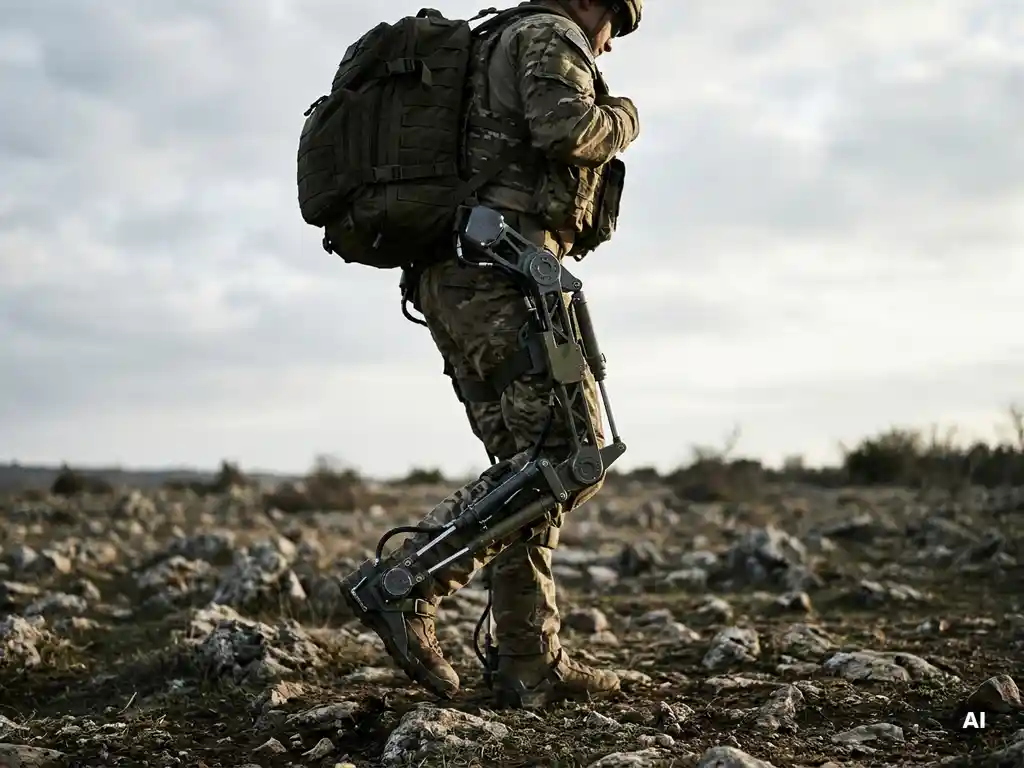
Wearable technology is changing load-carrying logistics in military operations by reducing the physical burden on soldiers, lowering injury rates, and extending operational endurance without requiring major changes to existing equipment or doctrine. Systems such as leg exoskeletons and smart load-distribution harnesses transfer weight away from vulnerable joints and muscles, allowing personnel to cover greater distances while carrying heavier loads. The questions below explore how these technologies work, where they fall short, and what the near future holds for military wearables.
What physical challenges do soldiers face when carrying heavy loads?
Soldiers routinely carry loads that exceed a third of their body weight, sometimes far more, across uneven terrain and over long distances. This places extreme stress on the knees, hips, lumbar spine, and ankles, leading to musculoskeletal injuries that are among the most common causes of long-term disability in military personnel. Fatigue accumulates faster under load, degrading decision-making, reaction time, and combat effectiveness.
The core problem is not simply weight but how that weight interacts with human movement. A heavy pack shifts a soldier’s center of gravity, forcing compensatory posture changes that strain muscles and joints in ways they are not designed to sustain over hours of walking. On rough terrain, each uneven step multiplies the mechanical stress on the lower body. Over a multi-day operation, even small biomechanical inefficiencies compound into serious injury risk and reduced mission capability.
How does wearable technology reduce physical strain in military logistics?
Wearable technology reduces physical strain by redistributing load forces away from the body’s most vulnerable structures and transferring them through a mechanical frame to the ground. Rather than the spine and legs absorbing the full weight of equipment, an exoskeleton or load-bearing device acts as a parallel load path, sharing or absorbing a significant portion of that force. This directly reduces muscle fatigue and joint stress during movement.
Beyond simple weight transfer, well-designed defense wearables work with the body’s natural gait cycle. Energy storage mechanisms, such as springs or elastic elements, capture energy during one phase of a step and release it during another, effectively recycling mechanical energy that would otherwise be lost. This makes each step more efficient, which is particularly valuable during long-distance marches or logistics runs where endurance matters as much as raw strength.
What types of wearable systems are used for military load carrying?
Military load-carrying wearables fall into three broad categories: passive systems, semi-passive systems, and powered (active) exoskeletons. Each represents a different trade-off between performance, weight, complexity, and reliability in the field.
- Passive systems use no electronics or motors. They rely entirely on mechanical elements such as springs, elastic bands, or rigid frames to redistribute load. They are lightweight, require no power source, and are highly reliable, making them well suited to austere field environments.
- Semi-passive systems incorporate mechanical energy storage and release mechanisms that are tuned to human movement without requiring active power input. They offer more sophisticated load management than purely passive designs while retaining the reliability advantages of not depending on batteries or motors.
- Powered exoskeletons use motors, actuators, and onboard computing to actively assist movement. They can provide the greatest performance gains but introduce significant weight, complexity, maintenance demands, and battery dependency, all of which create logistical challenges in operational settings.
For most current military applications, passive and semi-passive systems offer the most practical balance between performance and field reliability. Powered systems remain more common in controlled logistics environments such as base supply operations rather than dismounted patrol scenarios.
How do semi-passive leg exoskeletons work in field conditions?
Semi-passive leg exoskeletons work by using tuned spring or elastic mechanisms attached to the leg structure to store energy when the leg flexes under load and return that energy as the leg extends during the stride. This reduces the muscular effort required to carry weight over the ground, particularly during the stance phase of walking when the body is supporting its full load. No battery or motor is needed because the system is driven entirely by the user’s own movement.
In field conditions, this mechanical simplicity is a major advantage. There are no electronics to waterproof, no batteries to manage, and no software to update. The device works in mud, rain, extreme cold, and dusty environments where powered systems would face serious reliability concerns. Semi-passive designs are also generally lighter than powered alternatives, which matters when the device itself must be carried as part of the soldier’s overall load.
The key engineering challenge is tuning the mechanical response of the system to match the natural biomechanics of the wearer across varying speeds, terrain gradients, and load weights. A system optimized for flat-ground marching may perform poorly on steep ascents or when the soldier needs to move quickly. The most effective semi-passive designs account for this variability through adjustable spring rates or multi-mode mechanical configurations.
What are the limitations of current military wearable technology?
Current military wearables face several meaningful limitations that restrict widespread field deployment. The most significant include fit and adaptability challenges, performance trade-offs across different movement types, and integration with existing military equipment and clothing.
- Fit variability: Soldiers come in a wide range of body sizes and proportions. A device designed around an average body may perform poorly on individuals who fall outside that range, reducing both effectiveness and comfort.
- Movement restriction: Load-carrying exoskeletons are optimized for walking but can interfere with crouching, crawling, climbing, or rapid directional changes, all of which are essential military movements.
- Equipment compatibility: Military personnel wear body armor, carry weapons, and use specialized gear that must integrate with any wearable system. Designing around this complex equipment environment adds significant engineering complexity.
- Training and adoption: Any new device requires a period of adaptation. Soldiers must learn to move naturally with the system, and units must develop protocols for maintenance, storage, and deployment logistics.
- Durability under operational stress: Military environments are harsh. Systems must survive drops, impacts, exposure to water and extreme temperatures, and rough handling, all while remaining functional and safe.
These limitations do not make current defense technology ineffective, but they do mean that wearables are currently best suited to specific mission profiles, particularly logistics tasks, load-carrying marches, and base operations, rather than all-purpose combat use.
Where is military wearable load-carrying technology headed next?
Military wearable technology is moving toward lighter, more adaptive systems that can adjust their mechanical behavior in real time based on terrain, load, and movement type. The integration of embedded sensing and lightweight computing allows devices to respond dynamically to the wearer’s biomechanics without requiring full powered actuation, a direction often described as “smart passive” or “variable stiffness” design.
Microhydraulic systems represent one particularly promising development area, enabling precise, compact force control that was previously only achievable with larger powered mechanisms. Combined with advances in materials science, these approaches are pushing toward systems that are simultaneously lighter, stronger, and more responsive than current-generation devices.
Longer term, the convergence of wearable load-carrying technology with embedded health monitoring, navigation aids, and communications equipment points toward integrated soldier systems where the exoskeleton is one component of a broader connected platform. This direction is already visible in defense procurement discussions across several NATO member states, including ongoing development programs in the Netherlands and elsewhere in Europe.
How InteSpring helps with military load-carrying wearables
We at InteSpring develop engineering solutions that directly address the physical demands of military load-carrying logistics. Our work combines deep expertise in spring-based energy balancing, human biomechanics, and mechatronics to create wearable systems that perform reliably in the field. Our Centaur semi-passive leg exoskeleton is a concrete example of this approach in practice, developed in collaboration with the Dutch Ministry of Defense for use in low-risk approach marches, drop zone logistics, and forward base setups.
Here is what we bring to military wearable development:
- Patented spring-based load compensation that reduces leg muscle effort during extended load-carrying marches without requiring batteries or motors
- A modular four-phase development process covering feasibility, demonstrator, detailed design, and production-ready supply chain setup
- In-house prototyping and testing capabilities that allow rapid iteration between concept and functional prototype
- Specialist expertise in microhydraulics tailored to the wearable and exoskeleton market for applications requiring more dynamic force control
- Hands-on demonstration programs featuring over six different exoskeleton systems, allowing defense organizations to evaluate options before committing to development
Whether you are exploring the feasibility of a new load-carrying concept or looking for an engineering partner to bring a defense wearable from prototype to certified product, we are ready to help. Get in touch with our team to discuss your requirements and find out how InteSpring can support your program. You can also learn more about us and the technologies we have developed across defense, medical, and industrial applications.