
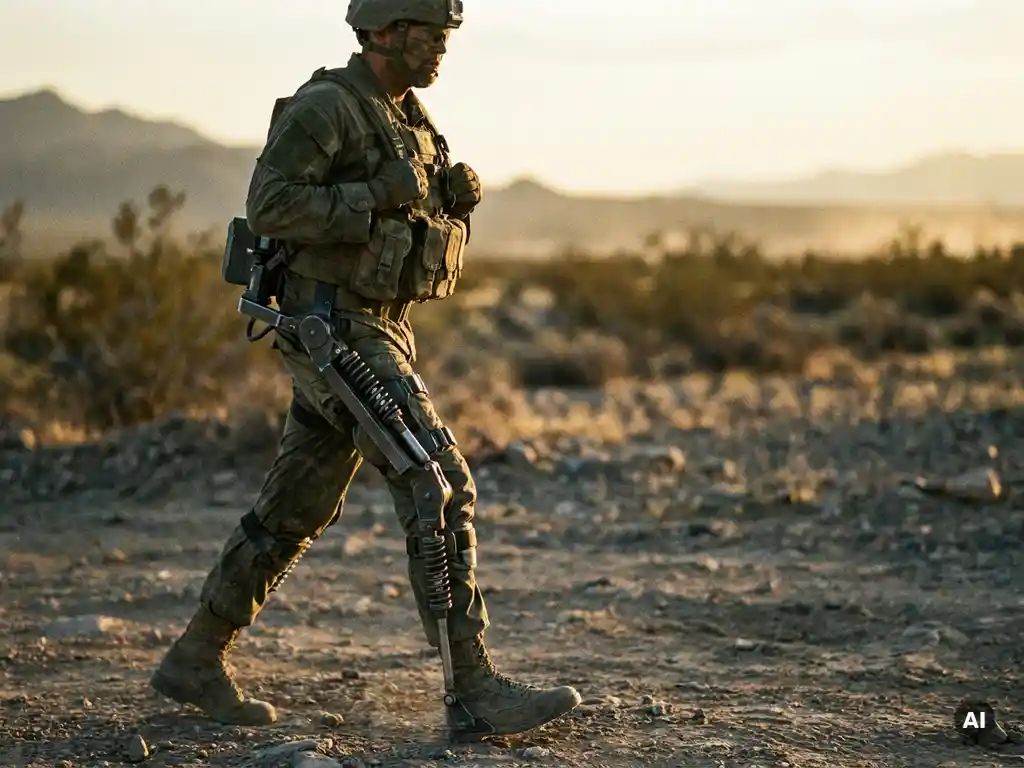
Military wearables reduce physical strain during combat missions by offloading mechanical stress from the body to engineered support structures, allowing soldiers to carry heavier loads, maintain better posture, and sustain performance over longer distances. These systems work by redistributing weight and absorbing forces that would otherwise accumulate in the joints, spine, and muscles. The sections below cover how these technologies work, who benefits most, and what limitations still need to be solved.
What types of physical strain do soldiers face during combat missions?
Soldiers on combat missions face a combination of musculoskeletal, cardiovascular, and cumulative fatigue-related strain. The most significant sources are load carriage, repetitive movement over uneven terrain, and sustained postures during tasks like aiming, digging, or equipment handling. Over time, these demands cause joint degradation, muscle fatigue, and injury that reduce both short-term performance and long-term health.
A typical infantry soldier may carry between 30 and 60 kilograms of equipment during an operational march. This weight compresses the spine, overloads the knees and ankles, and forces the body into compensatory movement patterns that accelerate fatigue. Logistical tasks at forward bases add further strain through repetitive lifting and carrying in confined or unstable environments.
Beyond the physical mechanics, sustained operations without adequate recovery compound the problem. Muscles that are already fatigued become injury-prone, reaction times slow, and decision-making degrades. Reducing the mechanical burden on the body is therefore not just a comfort issue but a genuine operational readiness concern for defense forces around the world.
How do military exoskeletons work to support the body?
Military exoskeletons work by creating a parallel load-bearing structure alongside the human body. Instead of muscles and joints absorbing the full weight of equipment and movement, the exoskeleton transfers a portion of that force through its own frame into the ground. This mechanical bypass reduces the energy the wearer must expend to move and stay upright.
The core mechanism varies depending on the design. Passive exoskeletons use springs, elastic elements, or carefully engineered geometry to store and release energy in sync with the body’s natural movement cycle. When a soldier takes a step, the spring system compresses and then returns energy during the next phase of the gait, reducing the muscular effort required with each stride.
Active exoskeletons add motors, sensors, and control systems to this framework. They detect movement intent and apply powered assistance in real time. While this allows for greater adaptability across tasks, it also introduces weight, battery dependency, and maintenance complexity that passive systems avoid entirely.
What are the main benefits of wearable technology for military personnel?
The main benefits of defense wearables for military personnel are reduced injury rates, extended operational endurance, and preserved physical capacity over the course of a mission. By lowering the biomechanical cost of carrying loads and performing physical tasks, these systems allow soldiers to arrive at their objective in better physical condition than they would without support.
- Reduced joint and spinal loading: Wearables distribute weight more evenly, reducing peak stress on the knees, hips, and lumbar spine during load carriage.
- Lower energy expenditure: Soldiers using spring-assisted leg exoskeletons consume less metabolic energy per kilometer, which translates directly into longer sustainable march distances.
- Injury prevention: Reducing cumulative mechanical stress lowers the risk of overuse injuries, which are among the most common causes of non-combat casualties in military operations.
- Preserved cognitive performance: Physical fatigue degrades attention and decision-making. Reducing bodily strain helps soldiers stay mentally sharp during extended missions.
- Logistics efficiency: At forward operating bases, wearables used during equipment handling reduce the physical toll of repetitive lifting and carrying tasks.
What’s the difference between passive and active military wearables?
The key difference between passive and active military wearables is whether they use an external power source. Passive wearables rely entirely on mechanical elements such as springs, elastic bands, or rigid linkages to redistribute forces. Active wearables use motors and electronics powered by batteries to provide dynamic, controlled assistance during movement.
Passive military wearables
Passive systems are lighter, mechanically simpler, and require no battery management in the field. They are well suited to predictable, repetitive tasks such as load-bearing marches where the movement pattern is consistent enough for a spring system to work efficiently. Their reliability in austere environments is a significant operational advantage, since there are no electronics to fail or batteries to run flat during a mission.
Active military wearables
Active systems can adapt to a wider range of movements and provide stronger assistance for tasks that require variable force output. However, they are heavier, more expensive, and dependent on power sources that must be recharged or replaced. In a field environment, battery logistics and system maintenance add operational complexity. Current research is focused on reducing weight and extending battery life to make active systems more practical for real-world defense applications.
For many military use cases, passive systems offer the better trade-off between performance and operational simplicity. Active systems are more appropriate for controlled environments or tasks where the power requirement is justified by the level of assistance needed.
Which military tasks benefit most from exoskeleton use?
Military tasks that involve sustained load carriage, repetitive manual handling, or prolonged physical effort in fixed postures benefit most from exoskeleton use. These are situations where the mechanical demands are predictable, the duration is long, and fatigue accumulation has a direct impact on mission success.
- Long-range approach marches: Carrying heavy personal equipment and weapons over extended distances is one of the highest-strain activities in infantry operations. Leg exoskeletons directly address this by reducing the metabolic and biomechanical cost of each step.
- Drop zone and forward base logistics: Unloading equipment, moving supplies, and setting up infrastructure involve repetitive lifting in environments without mechanical handling aids. Exoskeletons reduce the physical toll of these tasks.
- Medical evacuation: Carrying or supporting an injured person across difficult terrain places extreme demand on the rescuer. Wearable support systems can make this safer and more sustainable.
- Engineering and construction tasks: Soldiers involved in field fortification, bridge building, or equipment emplacement perform sustained heavy work that benefits from mechanical assistance.
What challenges remain in deploying wearables on active military operations?
The main challenges in deploying defense wearables on active military operations are weight, adaptability, durability, and integration with existing equipment. While laboratory and trial results are encouraging, translating that performance into real operational environments introduces constraints that are difficult to replicate in testing.
Weight remains a central tension. Any wearable system adds mass to the soldier, and if the system does not save more energy than it costs to carry, the net effect is negative. Passive systems have made significant progress here, but active systems still struggle to achieve a favorable weight-to-benefit ratio in field conditions.
Terrain adaptability is another challenge. Military operations take place across a wide range of surfaces, slopes, and obstacle types. A system tuned for flat-ground marching may perform poorly on loose soil, steep inclines, or when the soldier needs to crawl, sprint, or change direction rapidly. Wearables must accommodate the full range of soldier movement without restricting tactical agility.
Durability and maintenance in field conditions are equally important. Military equipment must function reliably in extreme temperatures, wet conditions, and dusty environments without access to specialized repair facilities. Systems with complex mechanical or electronic components face a higher risk of failure in these conditions.
Finally, integration with existing load carriage systems, body armor, and personal protective equipment is a practical barrier. Wearables must fit around existing kit rather than replace it, which adds design constraints and limits universality across different soldier builds and equipment configurations.
How InteSpring supports military wearable development
We at InteSpring work directly at the intersection of spring engineering, human movement, and defense technology. Our flagship product, the Centaur, is a lightweight semi-passive leg exoskeleton developed specifically for military load carriage. We are currently developing Centaur for the Dutch Ministry of Defense, targeting use cases including low-risk approach marches, drop zone logistics, and forward base operations. Our approach to reducing physical strain in defense applications is built on several concrete capabilities:
- Passive spring technology: Our patented energy-balancing mechanisms offload gravitational force without adding battery weight or electronic complexity, keeping systems field-ready and reliable.
- Human movement integration: We combine mechanical engineering with human movement studies to ensure our systems work in sync with natural gait rather than against it.
- Modular development process: From feasibility research through to certified product and supply chain setup, we guide defense partners through every phase of development with our four-phase consultancy approach.
- Hands-on demonstrations: We offer live exoskeleton demonstrations featuring over six different systems, giving defense organizations direct insight into what wearable technology can realistically achieve.
- Expert consultation: Our team provides guidance on wearable implementation strategies tailored to specific operational requirements.
If you are exploring how wearable technology can reduce physical strain in your defense operations, we would be glad to discuss what is possible. Get in touch with our team to start the conversation.
Related Articles
- How does spring-based energy balancing improve military wearable design?
- What is the difference between a prototype and a proof of concept?
- What are the different types of spring mechanisms?
- Balancing Solutions for Industrial Equipment: Types and Selection Criteria
- What are the main components of a hydraulic system?