
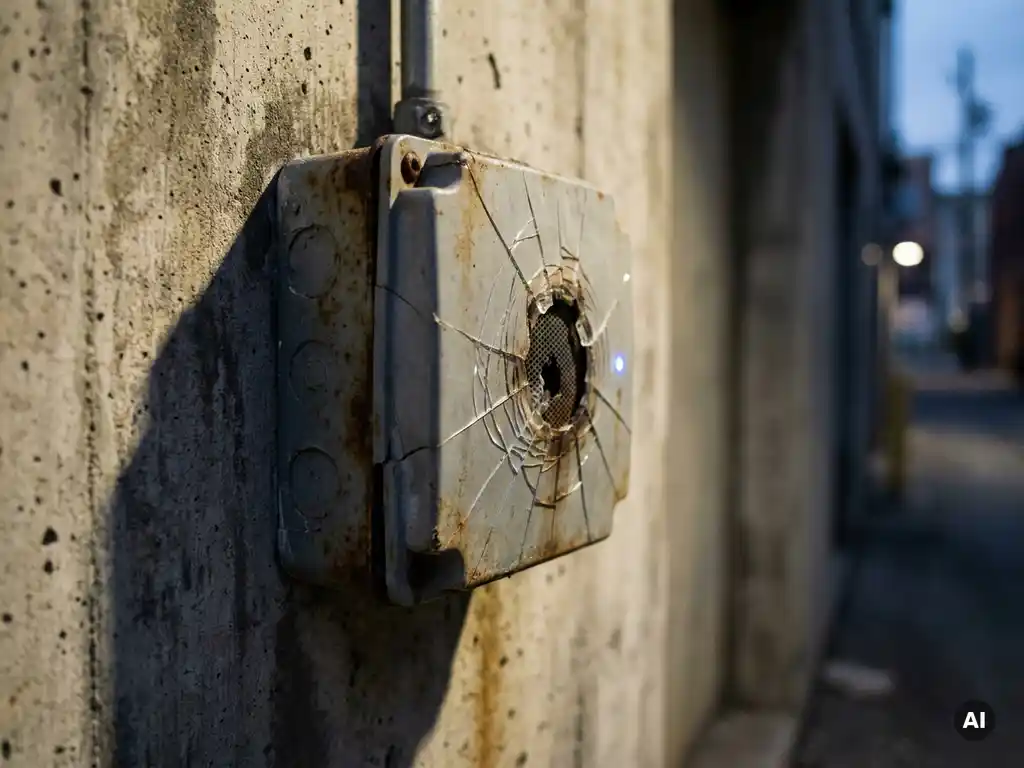
Traditional sensors struggle with gunshot detection accuracy primarily because gunshots produce complex, multi-dimensional acoustic and optical signatures that vary dramatically depending on environment, weapon type, and distance. Standard sensors are designed to detect specific signal patterns, but real-world gunfire rarely produces a clean, predictable signal. The sections below unpack the specific challenges that make reliable gunshot detection so technically demanding.
What makes gunshot detection so difficult for sensors?
Gunshot detection is difficult for sensors because a single gunshot produces a brief, broadband burst of energy that overlaps with many everyday sounds, from car doors slamming to industrial machinery. The event lasts only a few milliseconds, leaving sensors almost no time to confirm what they have detected before the signal disappears. This combination of brevity, spectral overlap, and environmental variability makes reliable classification genuinely hard.
Several physical factors compound the problem. Sound reflects off buildings, terrain, and vehicles, creating multiple arrival times at any given sensor. Weather conditions such as wind, temperature gradients, and humidity all alter how sound propagates. The weapon’s muzzle direction further changes the signal profile, meaning two shots fired from the same firearm can look very different to a sensor depending on where it is positioned relative to the shooter.
Why do acoustic sensors produce so many false positives?
Acoustic gunshot sensors generate false positives because they rely on detecting impulsive, high-energy sounds, and the real world is full of them. Vehicles backfiring, construction equipment, fireworks, and even large trucks hitting potholes can produce pressure waves that closely resemble the acoustic fingerprint of a gunshot. Without additional context, a threshold-based acoustic system cannot reliably distinguish between these events.
The core issue is that most traditional acoustic sensors apply relatively simple signal-processing rules, such as detecting a sudden spike in sound pressure level above a set threshold. This approach is fast but indiscriminate. More sophisticated classifiers can analyze frequency content and wave shape, but even these struggle in noisy urban or industrial environments where impulsive sounds occur frequently. The result is a high false-alarm rate that erodes operator trust over time, sometimes causing genuine alerts to be ignored.
How does sensor placement affect gunshot detection accuracy?
Sensor placement has a direct and significant effect on gunshot detection accuracy. A sensor positioned too far from a likely firing location will receive a weaker, more distorted signal, while a sensor placed near reflective surfaces will capture echoes that complicate analysis. Optimal placement balances line-of-sight coverage with distance constraints and minimizes interference from local noise sources such as HVAC units or traffic corridors.
In networked systems, the geometry of the sensor array is equally important. Accurate localization of a gunshot depends on measuring the difference in arrival times between multiple sensors, a technique known as time difference of arrival (TDOA). If sensors are too close together, those time differences become too small to measure reliably. If they are too far apart, synchronization errors between units introduce their own inaccuracies. Getting the spacing and orientation right is as much an engineering discipline as it is a deployment decision.
What’s the difference between acoustic and optical gunshot sensors?
Acoustic gunshot sensors detect the pressure wave, or muzzle blast, that a firearm produces when fired, while optical sensors detect the muzzle flash, the brief burst of infrared and visible light emitted at the moment of discharge. Each approach captures a different physical phenomenon, and each comes with its own strengths and blind spots.
Acoustic sensors
Acoustic systems can work around corners and through buildings because sound travels through air regardless of line of sight. They are effective over longer ranges and can detect the supersonic crack of a bullet in flight, which provides additional directional information. However, they are susceptible to ambient noise and require careful signal processing to avoid false positives.
Optical sensors
Optical systems are highly specific because a muzzle flash has a distinctive spectral signature that few other events replicate. They are less prone to acoustic false positives, but they require a direct line of sight to the weapon and can be defeated by suppressors, which reduce or eliminate the visible flash. Fog, smoke, and darkness can also degrade optical sensor performance, making them less reliable in adverse conditions. This is why most advanced systems combine both modalities rather than relying on either alone.
Why is gunshot localization harder than detection alone?
Detecting that a gunshot occurred is a binary problem, but localizing where it came from requires precise measurements across multiple sensors simultaneously. Localization depends on computing how much earlier the sound arrived at one sensor compared to another, and translating those time differences into a direction or position. Even small errors in timing, sensor position, or the assumed speed of sound can shift the calculated origin by tens of meters.
Environmental factors add further complexity. Wind changes the effective speed of sound in a given direction. Temperature layers in the atmosphere bend acoustic waves, a phenomenon called refraction, which can make a sound appear to come from a slightly different angle than the actual source. In urban environments, reflections from hard surfaces create ghost signals that can mislead localization algorithms into identifying a secondary reflection point rather than the true origin of the shot.
What sensor fusion approaches are improving gunshot detection?
Sensor fusion approaches improve gunshot detection by combining data from multiple sensor types, such as acoustic, optical, and seismic, so that the weaknesses of one modality are compensated for by the strengths of another. When an acoustic sensor flags an event and an optical sensor simultaneously detects a muzzle flash in the same direction, the combined confidence in a true positive rises sharply, and the false positive rate drops significantly.
Beyond simple multi-modal fusion, two developments are pushing detection accuracy further. First, machine learning classifiers trained on large libraries of real gunshot recordings can recognize subtle spectral and temporal patterns that rule-based systems miss. Second, event-based sensing using neuromorphic chips is emerging as a promising alternative to conventional sensor architectures. Unlike traditional sensors that sample data at fixed intervals, neuromorphic chips process signals only when a change occurs, mimicking how biological neurons fire. This makes them exceptionally fast and energy-efficient at detecting transient events like gunshots, while dramatically reducing the volume of irrelevant data that downstream algorithms must process. The combination of event-based sensing with conventional acoustic arrays represents one of the most significant advances in gunshot detection technology currently under active development.
How InteSpring helps with gunshot detection technology
We at InteSpring bring a distinctive engineering perspective to the challenges described throughout this article. Our expertise in mechatronics, embedded AI, and sensor integration means we understand not just the physics of detection but the full system design required to turn raw sensor data into reliable, actionable information. Specifically, we can support development teams and organizations working on gunshot detection in the following ways:
- Sensor system design: We help define the right combination of acoustic, optical, and event-based sensors for a given operational environment, including array geometry and placement strategy.
- Embedded AI and neuromorphic integration: We have hands-on experience integrating neuromorphic chip architectures and event-based sensing into compact, low-power hardware, directly addressing the false-positive and latency problems that traditional sensors face.
- Prototyping and demonstrators: Through our in-house prototyping capabilities, we can rapidly build functional demonstrators that allow stakeholders to evaluate detection performance in realistic conditions before committing to full-scale production.
- Feasibility and consultancy: Using our modular four-phase approach, from feasibility study through to certified product, we guide projects through the technical and regulatory complexity of bringing a new detection system to market.
If your organization is working on next-generation gunshot detection or any other sensor-driven safety application, we would be glad to explore how our engineering capabilities can accelerate your project. Get in touch with us to start the conversation, or learn more about InteSpring and the technologies we develop.