
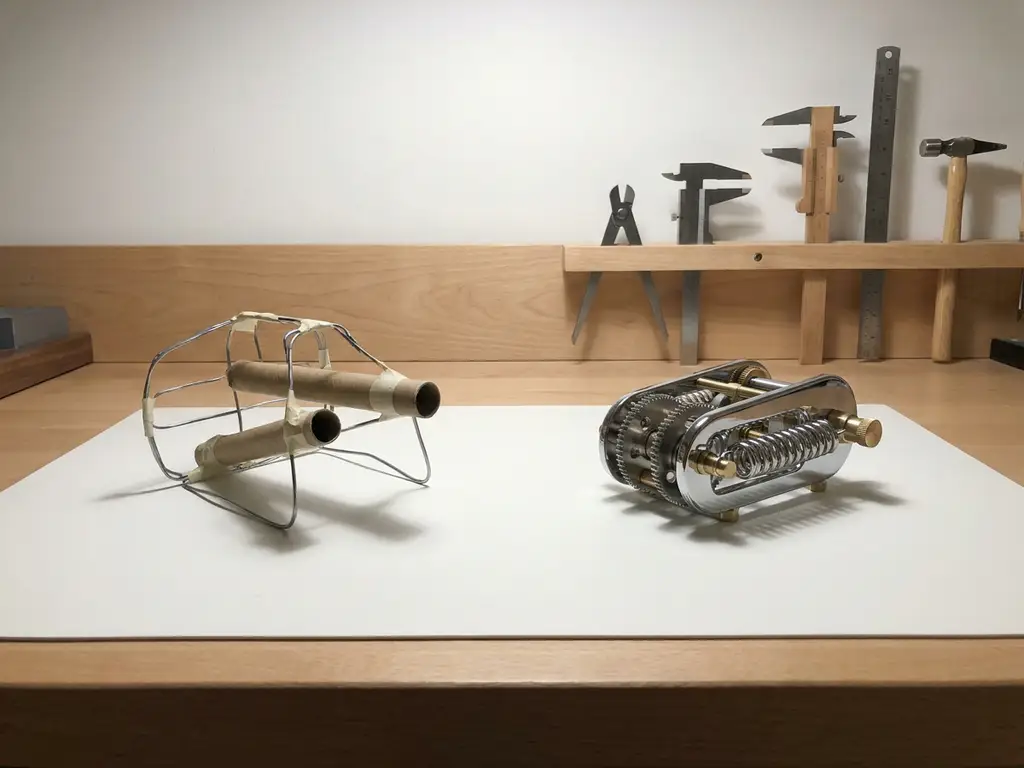
The difference between a prototype and a proof of concept lies in their purpose and development stage. A proof of concept (POC) validates whether an idea is technically feasible, while a prototype is a working model that demonstrates how the final product will function. POCs focus on proving core functionality, whereas prototypes refine design, usability, and performance for eventual production.
Rushing to prototyping without validation is burning your development budget
Many engineering teams jump straight into building detailed prototypes without first proving their concept works. This approach wastes months of development time and thousands in materials when the core idea has fundamental flaws. You end up with expensive models that look impressive but solve the wrong problem or use unworkable technology. Instead, start with a simple proof of concept that tests your riskiest assumptions using minimal resources. Validate the core mechanism, user need, or technical approach before investing in refined prototypes.
Building the wrong type of prototype is delaying your market entry
Teams often create prototypes that impress stakeholders but fail to answer critical development questions. A beautiful visual prototype might secure funding but tells you nothing about manufacturing costs or technical constraints. Meanwhile, competitors who build focused functional prototypes solve real engineering challenges and move toward production. Choose your prototype type based on what you need to learn next, not what looks most impressive in presentations.
What is a proof of concept and when do you need one?
A proof of concept is an early-stage demonstration that validates whether a specific idea or technology can work in practice. It focuses on proving feasibility rather than creating a polished product, typically addressing the riskiest technical assumptions before significant investment.
You need a POC when facing high technical uncertainty, exploring new technologies, or proposing innovative solutions without established precedent. POCs are essential when stakeholders question whether something is technically possible, when you’re combining technologies in untested ways, or when core functionality depends on unproven assumptions.
In engineering consultancy, POCs help clients understand whether their vision aligns with physical and economic reality. They answer questions like “Can this mechanism generate enough force?” or “Will users accept this interface?” before committing to full development cycles.
What is a prototype and what are the different types?
A prototype is a working model of a product or system that demonstrates specific aspects of the final design. Prototypes test functionality, usability, manufacturing processes, or market acceptance, ranging from simple mockups to near-production models depending on development stage and testing objectives.
Visual prototypes focus on appearance and user interface, helping stakeholders understand the product’s look and basic interaction flow. These work well for initial feedback and design validation but provide limited technical insight.
Functional prototypes demonstrate core mechanisms and performance characteristics. In mechanical engineering, these test load capacity, motion range, and component integration. They reveal technical challenges that visual models cannot address.
Production prototypes closely mirror final manufacturing processes and materials. These validate supply chain decisions, quality standards, and cost targets while identifying last-minute design issues before mass production.
How do you decide between building a POC or prototype first?
Build a proof of concept first when technical feasibility is uncertain, when you’re using unproven technology combinations, or when stakeholders need convincing that the core idea works. Start with a prototype when the technology is established but you need to refine design, test user experience, or validate manufacturing approaches.
Consider your biggest risk factors. If you’re unsure whether the fundamental mechanism will work, start with a POC that tests only that critical function. If you know the technology works but need to optimize size, weight, or user interface, begin with focused prototypes that address these specific concerns.
Resource constraints also influence this decision. POCs typically require fewer materials and less time, making them suitable when budgets are tight or timelines are short. Prototypes demand more investment but provide deeper insights into real-world performance and user acceptance.
What comes after proof of concept in product development?
After validating technical feasibility through a proof of concept, the next phase typically involves building functional prototypes that refine the design and test real-world performance. This progression moves from “Can we build it?” to “How should we build it?” and “Will users want it?”
The demonstrator phase follows POC validation, where teams create working models that showcase the concept to stakeholders and early users. These prototypes incorporate lessons learned from the POC while addressing practical concerns like size, weight, cost, and usability.
Design iteration comes next, involving multiple prototype cycles that progressively refine functionality, appearance, and manufacturing requirements. Each iteration answers specific questions about performance, user experience, or production feasibility.
Finally, the development process moves toward production prototypes and pilot manufacturing, where teams validate supply chains, quality processes, and cost targets before full-scale launch.
How InteSpring helps with prototype and proof of concept development
We guide clients through our proven four-phase development approach, ensuring each project moves efficiently from initial concept validation to market-ready products. Our modular methodology prevents costly missteps by matching the right development activities to your current stage and risk profile.
- Feasibility phase: We conduct thorough technical and economic viability research, helping you understand whether your concept can work before significant investment.
- Demonstrator development: Our team creates focused prototypes that prove core functionality while identifying key engineering challenges.
- Design optimization: We build functional prototypes that refine performance, usability, and manufacturing requirements through iterative testing.
- Production preparation: We establish sustainable supply chains and validate quality processes for successful market entry.
Our specialized expertise in spring systems, force balancing, and wearable technology ensures your prototypes address real-world performance requirements from day one. Contact our engineering team to discuss how we can accelerate your product development while minimizing technical and financial risks.