
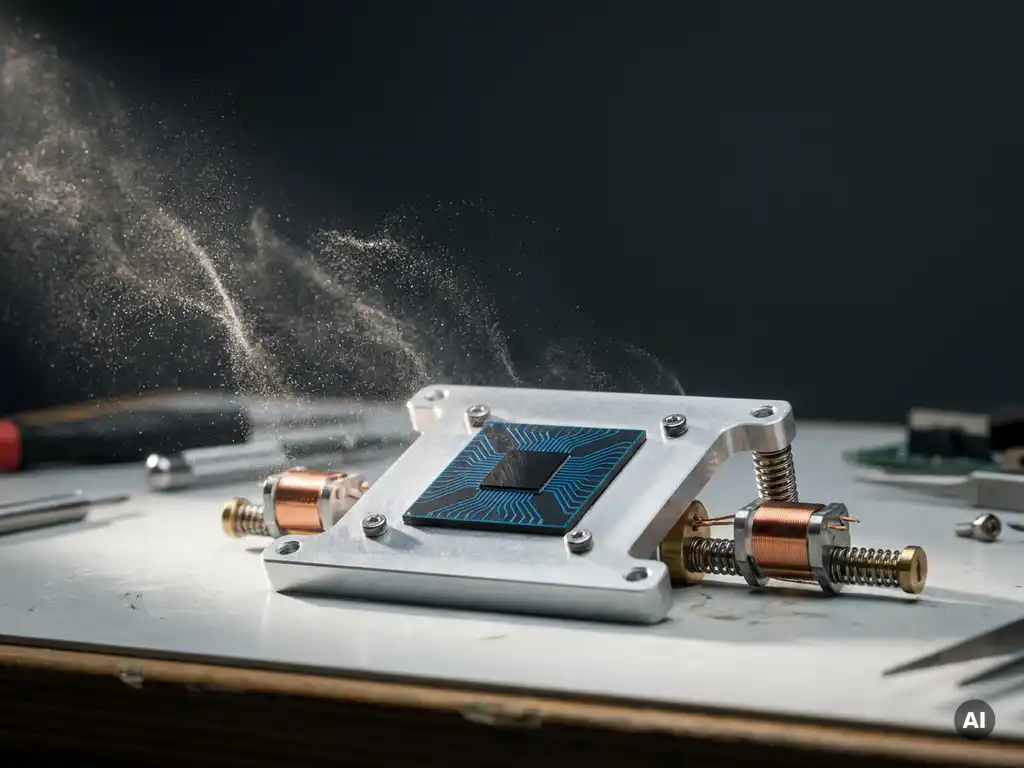
Neuromorphic chips cannot fully replace traditional sensors in acoustic detection yet, but they are rapidly closing the gap. These chips process sound in a fundamentally different way, mimicking the event-driven architecture of biological neural systems, which gives them real advantages in speed, power efficiency, and adaptability for demanding applications like gunshot detection technology. The sections below address the most common questions about where neuromorphic processing stands today and where it is headed.
How do neuromorphic chips process sound differently from traditional sensors?
Neuromorphic chips process sound using event-based sensing rather than continuous sampling. Instead of capturing audio at fixed intervals like a conventional microphone or analogue-to-digital converter, a neuromorphic chip only fires when it detects a meaningful change in the signal, much like how biological neurons respond to stimuli. This makes processing asynchronous, sparse, and dramatically more energy-efficient.
In practical terms, this means that silence or steady-state background noise generates almost no computational activity. The chip only “wakes up” when something acoustically significant occurs. For applications like gunshot detection technology, this is a critical advantage: the system can remain in a low-power idle state and respond within microseconds when an impulsive sound event arrives, without wading through continuous streams of audio data first.
The underlying architecture relies on spiking neural networks (SNNs), which encode information in the timing and rate of spikes rather than precise numerical values. This temporal coding is well-suited to transient acoustic events, where the timing of a sound onset carries as much information as its amplitude or frequency content.
What are the main limitations of traditional acoustic sensors?
Traditional acoustic sensors, whether microphones paired with digital signal processors or piezoelectric transducers, rely on continuous, clock-driven sampling. Their primary limitations are power consumption, latency in complex environments, and difficulty distinguishing target sounds from background noise without substantial post-processing.
In environments with high acoustic clutter, such as industrial facilities or active combat zones, conventional sensors must process every sample in the audio stream to extract meaningful events. This creates a computational bottleneck and increases energy demands significantly. For battery-powered or wearable systems, this is a serious constraint.
Additional limitations include:
- Fixed sampling rates that waste resources during quiet periods
- High sensitivity to environmental noise, requiring complex filtering algorithms
- Latency introduced by buffering and batch processing, which can delay response in time-critical scenarios
- Rigid signal pipelines that are difficult to adapt without hardware changes
These constraints become especially apparent in defense and logistics contexts, where sensors must operate continuously in unpredictable field conditions with limited power budgets.
Where are neuromorphic chips already used in acoustic applications?
Neuromorphic chips are already deployed in several acoustic application areas, including voice activity detection, keyword spotting, industrial anomaly detection, and early-stage gunshot detection technology. Research institutions and defense contractors have demonstrated working prototypes in each of these domains.
In consumer electronics, neuromorphic-inspired processing is used in always-on microphones that detect wake words with minimal battery drain. In industrial settings, event-based acoustic sensors monitor machinery for anomalous vibration signatures that indicate mechanical failure before it occurs.
Defense applications are perhaps the most demanding and the most actively funded. Acoustic gunshot localization systems benefit directly from the low-latency, event-driven response of neuromorphic architectures. Because a muzzle blast and its ballistic shockwave arrive as sharp transient events, event-based sensing vs. traditional sensors shows a clear performance difference: neuromorphic systems can timestamp the arrival of a sound spike with sub-millisecond precision, which is essential for accurate source triangulation.
Academic and government research programs in Europe and North America have published results showing neuromorphic chips successfully classifying impulsive acoustic events in real-world noise conditions, though most deployments remain at the pilot or prototype stage as of 2026.
What’s the difference between neuromorphic chips and conventional DSPs for audio?
The core difference between a neuromorphic chip and a conventional digital signal processor (DSP) is the processing paradigm. A DSP executes instructions sequentially on sampled data frames at a fixed clock rate. A neuromorphic chip processes information asynchronously, responding only to incoming spikes with no fixed clock governing when computation happens.
Energy and latency
DSPs are optimized for throughput and mathematical precision. They excel at tasks like fast Fourier transforms and filter banks applied to buffered audio. However, this comes at an energy cost that scales with sampling rate and processing complexity. Neuromorphic chips consume power only when events occur, making them orders of magnitude more efficient for sparse, event-driven tasks like detecting a sudden acoustic impulse.
Programmability and adaptability
DSPs are highly programmable and benefit from decades of mature tooling, software libraries, and industry standards. Neuromorphic hardware is still maturing in this regard. Designing spiking neural networks for specific acoustic tasks requires specialized expertise, and the ecosystem of development tools is considerably less developed than what surrounds conventional audio DSPs. For organizations evaluating event-based sensing vs. traditional sensors, this tooling gap is often the deciding practical factor in 2026.
Can neuromorphic chips match the accuracy of traditional sensors?
In specific, well-defined acoustic tasks, particularly the detection of impulsive events like gunshots, impacts, or mechanical faults, neuromorphic chips can match or exceed the accuracy of traditional sensors. For tasks requiring broad spectral analysis or precise audio reproduction, conventional systems still hold the advantage.
Accuracy in acoustic detection depends heavily on what is being detected. Neuromorphic architectures are naturally suited to tasks where timing precision and transient detection matter more than spectral resolution. Gunshot detection technology is a strong fit: a neuromorphic chip can identify the onset of a ballistic event faster and with less power than a DSP running continuous analysis.
Where neuromorphic systems currently fall short is in tasks requiring nuanced frequency discrimination over long time windows, for example, speaker recognition or complex speech understanding. These tasks benefit from the dense, precise mathematical operations that DSPs and GPU-based neural networks handle well. The gap is narrowing as spiking neural network training methods improve, but it has not yet closed for all acoustic classification scenarios.
When will neuromorphic chips be ready to fully replace acoustic sensors?
A full replacement of traditional acoustic sensors by neuromorphic chips is unlikely before the early 2030s for most applications, and may never be universal. The more realistic trajectory is a hybrid approach, where neuromorphic chips handle event detection and initial classification while conventional processors manage tasks requiring high-fidelity audio analysis.
Several factors will determine the pace of adoption:
- Tooling maturity: Development frameworks for spiking neural networks need to reach the accessibility and reliability of current DSP ecosystems
- Standardization: Industry and defense procurement bodies require validated, certified solutions before replacing established sensor chains
- Cost: Neuromorphic chips are currently more expensive to design around than commodity audio DSPs, though this is expected to change as production volumes grow
- Task specificity: Niche applications like gunshot detection technology or industrial fault detection are likely to see neuromorphic adoption far sooner than general-purpose audio systems
In defense and wearable technology contexts specifically, the pressure to reduce power consumption and improve real-time response is strong enough that neuromorphic adoption is accelerating faster than in consumer markets. By the late 2020s, hybrid sensor nodes combining event-based sensing with conventional signal chains are expected to become standard in high-performance acoustic detection systems.
How InteSpring Supports Advanced Sensing in Wearable and Defense Systems
At InteSpring, we work at the intersection of mechanical engineering, mechatronics, and embedded systems, precisely the domain where sensor technology choices have direct consequences for system performance. Our expertise in wearable platforms like the Centaur exoskeleton means we understand the real-world constraints that make low-power, high-responsiveness sensing so critical in defense and logistics applications.
We support clients navigating sensor integration challenges through our structured consultancy approach, which covers every stage from concept to certified product. Concretely, we can help with:
- Evaluating whether event-based sensing or traditional sensor architectures best fit your application requirements
- Integrating acoustic detection modules into wearable and semi-passive mechanical systems
- Prototyping and testing sensor nodes under realistic field conditions
- Advising on the trade-offs between neuromorphic and conventional DSP solutions for gunshot detection and situational awareness
- Connecting you with our specialist supplier network for embedded AI and microhydraulic components
If you are developing a system where acoustic detection performance, power budget, and physical form factor all matter, we would like to talk. Get in touch with our team to discuss how we can support your project from feasibility through to production-ready design.